
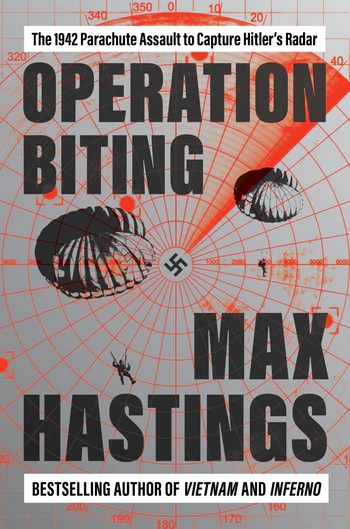
In early 1942, Winston Churchill faced a barrage of bad news. Kriegsmarine warships had escaped detection, sailing from occupied France to Germany, and Singapore had just fallen to the Japanese. The time for a large-scale offensive had not yet arrived, but Churchill desperately needed a victory. German radar technology – the Würzburg – was hindering British air operations, and one station, perched on the cliffs of Bruneval near Le Havre in Northern France, became the target of a daring raid. A successful breach of the Nazi fortress would offer much-needed relief during those harsh winter months.
Thus, Operation Biting: The 1942 Parachute Assault to Capture Hitler’s Radar (Harper) vividly springs to life through Sir Max Hastings’ writing. Members of the Black Watch, the Cameron Highlanders, the King’s Own Scottish Borderers, and the Seaforth Highlanders took center stage among the British paratrooper units involved, demonstrating the martial prowess long associated with Caledonian regiments. Nemo me impune lacessit.
Unmistakably, Churchill is the story’s central figure. During the Boer War, which he covered as a young war correspondent, he admired the effectiveness of Afrikaner commandos. True to the British instinct of adapting enemy tactics, Churchill later founded the Special Operations Executive (SOE) in 1940, followed by the formation of the Special Air Service (SAS) the next year. As Hastings notes, the recruits manning these units “were seldom the sort of people to make docile household pets.” The deployment of paratroopers for Operation Biting naturally stemmed from this evolution.
Continue reading “The Caledonian Invasion” BookMarc