
Any passerby on Whitehall in London walks in front of three statues representing towering British military figures of World War II. The most iconic one is naturally the one representing Viscount Montgomery, the victor of Alamein. Then there’s one of Viscount Alanbrooke, who headed the British Army during the conflict. The third and last one along the way – if you come from the House of Commons – depicts Viscount Slim, the victor of Burma. While I have devoured countless articles and books about Monty and read many things on Alanbrooke, my knowledge about the last member of the trio is scant at best. Mea culpa.
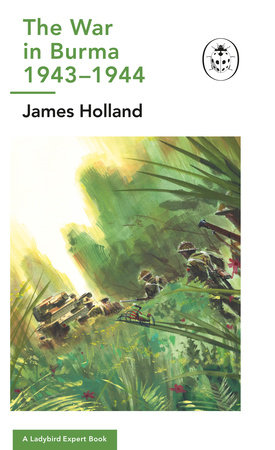
A few weeks ago, The War in Burma 1943-1944 by renowned military historian James Holland came to my attention. I dove right into it with delight. True to his eloquence and unparalleled expertise (I’m a huge fan of his documentaries and I have another book of his on my shelves), this engaging historian broadened my horizons about an aspect and a figure of World War II about which I knew too little.
Published as part of the Ladybird Expert Book collection, the most recent addition to James Holland series is beautifully enhanced by Keith Burns’ stunning and evocative illustrations summarizes the significance of the much too unknown South-East Asian theatre of World War II. Northwest Burma, the prolific historian writes, was “one of the most inhospitable places to fight in the world.” By the end of 1944, the Japanese were on the move to smash British troops on their way to India, hopefully end the British Raj and thwart the delivery of essential supplies to Chiang Kai-shek’s Nationalists in China who were also fighting the Japanese toe and nails. The stakes were unparalleled, and the British couldn’t afford to lose any ground. Outnumbered and demoralized, how could they reverse the tide?
That’s were William “Bill” Slim – commander of the British Fourteenth Army – came into play. As Ryan Holiday wrote about Ulysses S. Grant in a lesson about the Stoics, “he was a leader and when leaders arrive, they make a difference.” The same applied here. With the support of Admiral Lord Louis Mountbatten, the Supreme Allied Commander Southeast Asia with whom he had a “very strong working relationship”, Slim ingeniously turned the Japanese strategy against them. “They were expecting the British to act the way they always had – and retreat.” They were in for quite a surprise. The British commander plan was to conduct a “fighting retreat”. Knowing that his enemy “would not dare give up, but rather would keep fighting”, he could count on troops whose morale he had contributed to bolster and who were in no mood to cede an inch of ground to the Japanese, who were in the same state of mind. The stage was set for an iconic clash and the Japanese Fifteenth Army, under the command of the arrogant and contemptuous General Renya Mutaguchi, would be brought to its knees.
“After sixty-four days of ferocious fighting, the [Burma] road was open.” The Japanese plan of conquering India now lied in a pile of cadavers. The reconquest of Burma was far from over, but Slim and his soldiers had performed “an astonishing reversal of fortunes that could not have been remotely guessed at just twelve months before.” The “Forgotten Army,” had performed the unthinkable feat of winning one of the greatest battles of World War II.
Truth be told, Slim was much less idiosyncratic than his neighbor-in-posterity on Whitehall, which probably explains why he generates less interest than Montgomery. Through this book, whose length is inversely proportionate to its subject’s contribution to Allied victory in 1945, James Holland offers the reader the opportunity to discover a giant of polemology who deserves much more attention than he receives, like the battlefield where he won his laurels. If only for that reason, this captivating book deserves a place of choice on the bookshelves of any military history enthusiast.
I naturally intend to keep on learning more about Slim and the South-East Asian theatre. Parallel to that, I will devour every book of this incomparable Ladybird collection under James Holland’s pen, for he is a master of the art.
________
James Holland, The War in Burma 1943-1944, London, Ladybird Books (Penguin Random House), 2023, 56 pages.
 BookMarc
Dear Marc,
I was interested to read your comments on my colleague, James Holland’s latest offering – this time on the Burma campaign. His output is prodigious and hugely popular.
Given your interest in the military statues that stand on the Whitehall front of the Ministry of Defence you should be aware that just one hundred yards or so from that of Viscount Slim and just around the corner into Horse Guards in front of the Ministry’s North Door is a fine Gurkha statue that complements those of the three Field Marshals.
Field Marshal Slim himself belonged to a Gurkha Regiment and the Gurkha Battalions contribution to Slim’s victory was immense – the 27 Gurkha Battalions that fought in Burma were a key component of the 14th Army and of the Chindits. The nine Victoria Crosses awarded to the British Officers and their Gurkhas are a permanent reminder of their contribution.
I haven’t yet read James’s new book but I hope he recognises that contribution.
Best wishes Peter Duffell
LikeLike
Good morning Sir Peter! Many thanks for your comments. The Gurkhas and Chindits are mentioned in passing in the book and there is no mention of Viscount Slim’s association with them. This being said, the book is a summary of the campaign, in the scope of 56 pages with illustrations. You have now piqued my curiosity though and I’ll be looking for material to read on the subject, because it seems as fascinating as it is pertinent. I’m now looking forward to returning to London to see the Gurkha statue.
LikeLike