
In a recent book about FDR and Churchill, historian James B. Conroy recounts how the iconic British Prime Minister convinced the US President to choose the option of attacking the underbelly of the Axis, namely North Africa and Italy, rather than an early landing in France. But more about it later.
Any traveler from Rome disembarking the train at Monte Cassino is granted the unique spectacle of the breathtaking view of the iconic 6th Century Benedictine monastery overlooking the town. Only then can you fully grasp the magnitude of what Allied soldiers endured on their way to Rome.
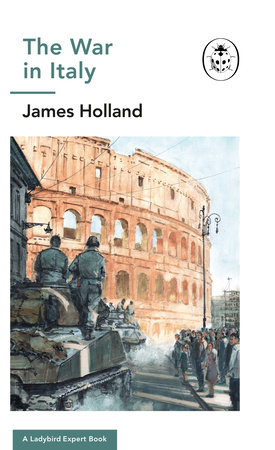
Yet, despite its cruciality, the Italian front is a poor cousin of World War II history. Renowned historian James Holland’s work contributes to correcting that perception. He notably does so in a brief but evocative book he devotes to The War in Italy as part of the excellent Ladybird Expert series. Between the covers, James Holland notably illustrates that, far from disengaging the enemy, German troops did everything they could to block its way North. For instance, he writes that the bombing of the Monte Cassino Abbey made the position stronger for the 1st Fallschirmjäger paratroopers who reinforced the Gustav Line in that sector. British General Harold Alexander’s 15th Army Group would not be celebrating Christmas 1943 in the Eternal City. Hitler’s troops were anything but a spent force. They would stubbornly defend their positions “for over a year and a half”. On the Allied side, the landings at Salerno (Sicily) were “very nearly a catastrophic failure”, foreshadowing hardships to come.
For the soldiers in both camps, the fighting was exceptionally brutal. Mud, rain, bitter winter, dust, dysentery, and malaria also contributed to slowing down operations, notably on the Allied side. Light years from postcard pictures of the picturesque landscape. Those wearing the uniform were not the only victims of the ghastly combats. Civilians “were paying a terrible price for Mussolini’s entry into the war back in 1940”, writes the historian.
Italians deserve much more credit for their resistance to Hitler’s and Mussolini’s hordes than they receive. James Holland evokes the estimation of Field Marshal Albert Kesselring, who oversaw the German defense of the peninsula, according to whom Italian insurgents were responsible for the death of at least 30 000 of his soldiers. Hitler’s strategist was not going to sit on his hands. Retaliation was brutal. The author mentions the “largest single civilian massacre in all of western Europe during the war” perpetrated by “men of the 16th Waffen-SS Division” on September 29, 1944.
Another similar event occurred on March 24, 1944, 5 kilometers southeast of Rome. On that day, 335 civilians were massacred in the Adreatine Caves, in reprisal for an attack launched the previous day in Rome against the SS Police Regiment. Civilian sufferings – sadly also resulting from actions committed by the men of the French Expeditionary Corps – can also be remembered 12 kilometers southeast of Monte Cassino in the abandoned village of San Pietro where some residents hid in caves to shelter from the fighting.
Anyone with even a scant interest in the history of World War II in Italy can easily grasp the magnitude of the sacrifices borne by the Italian populace, whose heart it can be argued was not totally engaged in the war. Ultimately, it paid off because the Italian partisans were able to exact a huge toll on the German war effort by wreaking havoc with their supply lines.
Borrowing from the author’s description of mountain combats in the center of the country, the reader realizes that victory in Italy came at the price of enormous and inspiring “grit, determination and sacrifice”.
All in all, Churchill was vindicated in his calculation that the underbelly of the Third Reich was the right place to strike the enemy rather than risk a premature landing across the Channel, because “the long, bitter war in Italy was part of the wider and ultimately effective Allied strategy of tightening a noose around Nazi Germany.”
In the span of 56 pages, James Holland certainly can’t quench the thirst for details about a specific nation or unit’s contribution. But he offers a brilliant and eloquent summary of a war theater that deserves much more attention than it generally receives. The War in Italy was a missing title on my bookshelves.
_________
James Holland, The War in Italy, London, Ladybird Books Ltd. (Penguin Random House Canada), 2021, 56 pages.
I would like to express my heartfelt gratitude to the Publicity Department of Penguin Random House Canada for providing me with a copy of that book.
 BookMarc