
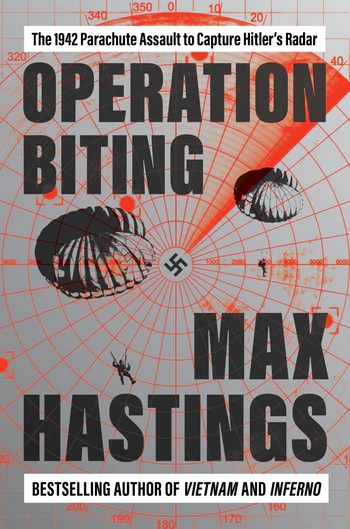
In early 1942, Winston Churchill faced a barrage of bad news. Kriegsmarine warships had escaped detection, sailing from occupied France to Germany, and Singapore had just fallen to the Japanese. The time for a large-scale offensive had not yet arrived, but Churchill desperately needed a victory. German radar technology – the Würzburg – was hindering British air operations, and one station, perched on the cliffs of Bruneval near Le Havre in Northern France, became the target of a daring raid. A successful breach of the Nazi fortress would offer much-needed relief during those harsh winter months.
Thus, Operation Biting: The 1942 Parachute Assault to Capture Hitler’s Radar (Harper) vividly springs to life through Sir Max Hastings’ writing. Members of the Black Watch, the Cameron Highlanders, the King’s Own Scottish Borderers, and the Seaforth Highlanders took center stage among the British paratrooper units involved, demonstrating the martial prowess long associated with Caledonian regiments. Nemo me impune lacessit.
Unmistakably, Churchill is the story’s central figure. During the Boer War, which he covered as a young war correspondent, he admired the effectiveness of Afrikaner commandos. True to the British instinct of adapting enemy tactics, Churchill later founded the Special Operations Executive (SOE) in 1940, followed by the formation of the Special Air Service (SAS) the next year. As Hastings notes, the recruits manning these units “were seldom the sort of people to make docile household pets.” The deployment of paratroopers for Operation Biting naturally stemmed from this evolution.
Churchill had a well-known fondness for mischief-makers, such as “the brilliant maverick Col. Dudley Clarke,” familiar to any SAS enthusiast and making a memorable cameo in the book. It was no surprise, then, that Churchill appointed another colourful character, Commodore Lord Louis Mountbatten, to lead the mission. As Hastings writes, the aristocratic centurion “was panting for an opportunity to carry his war to the enemy.” Charismatic and admired by the Americans for his flair, “Mountbatten was a rising star in the only firmament that mattered, that of the PM.” He would later oversee Operation Jubilee in Dieppe and command Allied operations in Burma.
Adding to the confusion of the fog of war and the disorganized defense of the radar site is the ironic twist that the Luftwaffe troops guarding it were under the command of none other than Mountbatten’s cousin, Captain Prince Alexander-Ferdinand von Preussen. AWOL on the night of the assault, he later faced disciplinary consequences. As Hastings implies, the disarray of the Luftwaffe unit only heightened the contrast with the precision and daring of the British raiders.
Bruneval’s success propelled British airborne forces into a new strategic role. Figures such as Major General Frederick “Boy” Browning and Major John Frost—both key figures in Operation Biting – would later lead in Operation Market Garden. Hastings notes that Frost “deplored the decision to launch [it] in daylight: experience at Bruneval and elsewhere had convinced him the Germans disliked fighting in darkness, a vulnerability that should have been exploited.” That missed lesson would come at a significant cost.
The raid that unfolded on the night of February 27–28, 1942, came with formidable challenges. Stealth was paramount. As Hastings observes, “It was plain to everyone from Mountbatten and Browning to the humblest Scottish soldier that surprise, and only surprise, could confer success. If the Germans were expecting them, the little force was doomed.” The team also faced the risk of missed drops, “failure of inter-service communication”, mishandling by the Navy, the critical need to capture prisoners for intelligence purposes, and reliance on the brave few of the French Resistance.
By dawn, the mission had succeeded. Churchill and his paratroopers had pulled off what Hastings calls “a brilliant little coup which lifted the spirits of Churchill’s people, and impressed their enemies as had few actions of the British Army since the onset of war.” If only for the psychological uplift it provided, Operation Biting is essential reading – a vivid testament to how daring, ingenuity, and sheer resolve can tilt the battlefield in favour of the bold. Bruneval would become the first battle honour of the newly formed Parachute Regiment, which was destined to carve out a lasting place in the annals of military history.
And truth be told, this might be Sir Max’s most captivating book yet.
_____
Sir Max Hastings, Operation Biting: The 1942 Parachute Assault to Capture Hitler’s Radar, New York, Harper, 2024, 384 pages.
 BookMarc