
In the new world order that is taking shape, the special relationship between Israel and the United States remains paramount. To paraphrase Sir Winston Churchill’s description of his relationship with President Franklin D. Roosevelt, “No lover ever studied every whim of his mistress” as closely as Benjamin Netanyahu did those of President Donald Trump. It therefore came as no surprise that the Israeli Prime Minister celebrated the arrival of 2026 last week at Mar-a-Lago. No one can dispute that Bibi is unparalleled when it comes to possessing a keen sense of history. But no statesman is eternal, and some actors are already jockeying to succeed him.
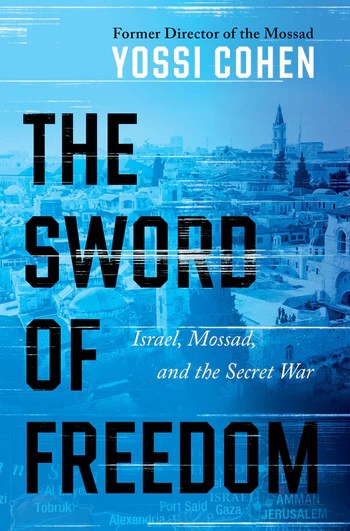
Former Mossad director Yossi Cohen is said to be among them, and the publication of his riveting memoir—The Sword of Freedom: Israel, Mossad, and the Secret War (Broadside Books)—will do little to calm speculation about a potential bid. The narrative spans forty-two years of service to Israel, at the heart of some of its most secret operations, including the iconic 2018 mission in which Mossad operatives seized Iran’s nuclear archives from a clandestine warehouse south of Tehran. Cohen notably served under the legendary Meir Dagan—who took him under his wing and is believed to have later recommended him to Prime Minister Netanyahu as a successor—and his aptitude for human relations, clearly a strength, naturally pointed him toward public life.
Yossi Cohen’s childhood home was modest, “but full of books”. He professes a “passion to learn from history”, which is evident in his frequent references to Churchill, Eisenhower, Bismarck, Nelson Mandela, Cicero, John Wayne, or in his borrowing “from one of England’s great hymns”. I was particularly struck by the anecdote recounting Egyptian President Anwar El-Sadat’s interest in the Battle of Gettysburg during his studies at the Royal Military Academy in Cairo. As a final example, the author even quotes Calvin Coolidge, to whom the words “persistence and determination alone are omnipotent” are attributed—a sentiment unlikely to displease the 47th President, who shares important dispositions with this tariffs-inclined predecessor.
Beyond the bookshelves, what is even more revealing is the author’s razor-sharp realism. “Autocracies are incredibly difficult to undermine”—that is, unless they are removed by force or through the flames of revolution. It is therefore necessary to deal with them, even if we “may instinctively disagree with the nature” of such regimes. But one should not expect the author to lecture them. On the war in Ukraine, he bluntly states that it is not in Israel’s interest to become involved, as the relationship with Moscow “is paramount”. Along the way, the former Mossad director calls for a “greater understanding” of Vladimir Putin’s motivations, while also expressing “great faith” in Saudi Crown Prince Mohammed bin Salman. Such positions would be difficult to defend in Europe or in certain North American circles—but that is not Yossi Cohen’s audience. What emerges clearly from these memoirs is his acute sensitivity to the human factor and the central importance he assigns to personal relationships. This approach would serve him particularly well in dealings with the great-power actors who dominate the international chessboard.
Central to the author’s worldview, personal rapport also informs his preferences in American politics. He expresses his pleasure at President Trump’s return to the White House in 2025, praising the POTUS’s sense of loyalty and sharing his belief that Trump “is unfairly maligned, especially in Europe”. A transition between Benjamin Netanyahu and the former director of the Mossad would therefore likely be smooth when it comes to relations with the sitting president, whom he describes as “an unorthodox peacemaker”.
Such affinities may be difficult to understand—or to digest—for some Western audiences, but the singular environment in which Israel has been compelled to operate since its birth must be taken into account. Jerusalem, Cohen reminds us, “is accustomed to standing alone”. It does not have the luxury of making the wrong turn in matters of geopolitical alignment. The Realist posture he espouses is bound to be controversial. But the world order is not a popularity contest, and Yossi Cohen is not campaigning to become Secretary-General of the United Nations.
All in all, The Sword of Freedom reads as an eloquent declaration of intent for the Prime Ministership. “Power by its nature does not necessarily corrupt, but if you cling on too long in the belief you are invulnerable, you invite trouble”. It is a not-so-subtle way of urging the current resident of Balfour Street to pack up his boxes—something I do not expect him to do, nor do I see him conceding victory this year.
“Leadership is about stressing what you can do for your followers, rather than the other way around”. Throughout the book, Yossi Cohen demonstrates an intimate command of the legacies of David Ben-Gurion, Ze’ev Jabotinsky, and Menachem Begin, and a clear determination to walk in the footsteps of these founding fathers in defence of the State of Israel and its people. After all, he brings more than four decades of experience to the table. Whether he could transition effectively from the shadows to the hustings, however, is another matter entirely.
Jean Tulard, the renowned French historian and biographer of Napoleon, once wrote that memoirs exist either to explain oneself or to boast. Cohen cannot fully explain his career, much of which will remain classified for years—if not forever. As for boasting, he does what any aspiring politician would: he showcases his qualities and aptitudes. Should he enter the political arena, readers will have the opportunity to measure his performance against this first draft of history. For now, The Sword of Freedom stands as a riveting read for enthusiasts of espionage and for students of Israel’s central role in world affairs.
_____
Yossi Cohen, The Sword of Freedom: Israel, Mossad, and the Secret War, New York, Broadside Books, 2025, 288 pages.
 BookMarc