
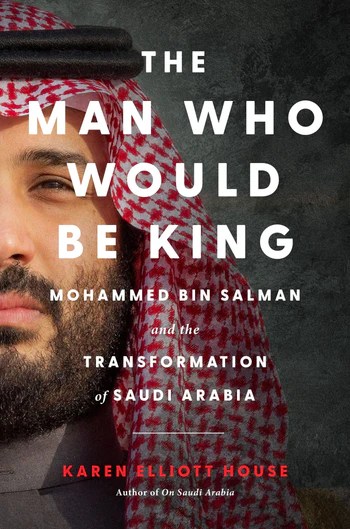
“If you don’t stand out, you might as well disappear”, said Saudi Crown Prince Mohammed bin Salman. Since the beginning of the reign of his father, King Salman bin Abdulaziz Al Saud, the rise of the heir to the throne has been nothing short of meteoric. In an informative and enthralling new biography, veteran journalist Karen Elliott House seeks to explain the forces that shaped him. Moving with speed, innovation, and determination, MBS has become an essential piece on the international chessboard.
After King Abdullah’s death in January 2015, the young prince moved quickly to consolidate his father’s prerogatives as the new sovereign—so much so that “King Salman and his son are indisputably the strongest rulers in the history of Saudi Arabia”. As the sixth son of the new king, MBS would not normally have been expected to become heir to the throne. But that is precisely the point: he was not supposed to. He outmaneuvered any potential opposition to his father’s reign—over which he came to wield decisive influence—neutralizing roadblocks from extended family members, religious fundamentalists, and other detractors. One of the most striking examples of his boldness unfolded at Riyadh’s Ritz-Carlton on the night of November 4, 2017, when what began as a financial discussion ended with what could be described as a tax readjustment to correct wrongdoing. As a student of history, MBS heeded Singapore’s founding father Lee Kuan Yew’s advice to clean the stairs starting at the top.
Napoleon, whom the author mentions on many occasions in the book, famously said, “The future destiny of a child is always the work of the mother”. MBS is no exception to that rule. The “son has inherited the strong will of his mother and the royal power of his father”, whose conduct he closely observed. A family tutor also confided that, as a child, the Crown Prince was “something of a prankster”. As a fan of Tintin, reading that passage reminds me of the mischievous, endearing young Prince Abdullah, featured in Tintin in the Land of Black Gold and The Red Sea Sharks. MBS broke the mould in a country where “citizens were accustomed to their leaders being elderly and largely inactive”. Not anymore.
The kingdom founded by Ibn Saud will never be the same again. His passion for soccer, gaming, and Star Wars has translated “in shifting the legitimacy of the Al Saud from religion to nationalism”. With his eyes on the future, MBS knows that young people are his audience, and he is building that future on the pillars of imagination, innovation, and initiative. Under his leadership, “the kingdom is marketing itself as a destination of big-time sports”. It is no coincidence that legendary Cristiano Ronaldo has been playing for Al Nassr since 2023, contributing to making Saudi Arabia a hub for the sport. The prince, who sported a “Barbour jacket over his traditional Saudi thobe” at a Formula E electric car race, understands that sport is a powerful driver of culture and society.
At the intersection of science and women’s rights, astronaut Rayyanah Barnawi—who studied biomedical research—“spent ten days in space in 2023”, something that would have been unthinkable before. Among the innovative technologies being deployed to build the future of the kingdom, Saudi Arabia also seeks to become the number one destination “for global AI data centers by meeting their enormous energy needs at the lowest price.” Regional tensions involving Iran notwithstanding, MBS moves quickly, shrewdly, and with assurance.
Beyond the sweeping transformation in domestic affairs, MBS is also redrawing the contours of Saudi Arabia’s role in world affairs, arguably becoming “the first Saudi leader to seek a prominent role in global politics since the Islamic conquest 1,400 years ago.” For centuries, the kingdom has stood at the crossroads of great power politics. Over the last few decades, its foreign policy has aligned with those who have shaped it. The Abraham Accords represent a shift that Saudi Arabia is said to have been on the verge of embracing when horror struck Israel on October 7. One of Hamas’s key objectives in launching its attack was likely to derail that process. Closer relations between Riyadh and Jerusalem would pose a serious challenge for those who seek the demise of the Jewish state.
Another significant change in recent years concerns alignment with the United States, whose reliability is increasingly being questioned. The kingdom’s gaze is also turning toward China, the kingdom’s largest trading partner due to its deep dependence on Saudi oil imports”. Karen Elliott House also notes that “MBS has mandated teaching Chinese (along with English) in Saudi schools and his own children are studying the language.” The author frequently invokes Napoleon, but MBS himself appears keen to hedge his bets—because no one knows what lies on “the other side of the hill,” to borrow the words of the Duke of Wellington.
At 40, Mohammed bin Salman still has time as an ace up his sleeve. Set to become the youngest monarch since Ibn Saud, he seems poised—assuming the same determination he once showed in defending his father’s prerogatives—to endure as a transformative force. The smiling prince has already shown he can run the game with an iron fist. Karen Elliott House’s biography thus offers an excellent study for anyone seeking to better understand the character and motivations of a pivotal—and increasingly unavoidable—figure shaping the emerging geopolitical order. It is also a remarkably compelling and engaging read.
_____
Karen Elliott House, The Man Who Would Be King: Mohammed bin Salman and the Transformation of Saudi Arabia, New York, Harper, 2025, 304 pages.

