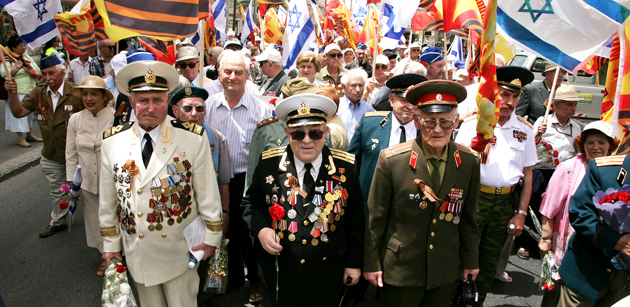
The best soldiers of the Red Army?

Permit me to come back on the subject of Victory Day celebrations and Russian (Soviet) veterans. I’m coming back on it because this is a neglected aspect of World War II history.

When I watched those Jewish-Israeli Soviet veterans marching in Israel last week-end, I started looking for some books or articles on this subject. After all, this blog is not called “Books and Bayonets” for nothing.

And I found an excellent article by historian Kiril Feferman about the “’The Jews’ War’: Attitudes of Soviet Jewish Soldiers and Officers Toward USSR in 1940-41” in The Journal of Slavic Military Studies (vol.27, no 4, 2014), which is edited by none other than military historian David M. Glantz.

This article covers the attitudes and motivations of Jewish soldiers who fought under the hammer and the sickle banner during WW2. Before the Nazi invasion of June 22, 1941, “[…] a minority of the Jewish military men held indifferent or even hostile attitudes toward the Bolshevik regime.” But that was to change.

The German attack against the USSR “[…] promptly transformed all Jewish soldiers and officers into the staunchest anti-Nazi force and hence, probably one of the most reliable groups in the Red Army. This occurred even before the knowledge of the Holocaust became widespread.”

What motivated them to act in such a way? A combination of the desire to be fully recognized as citizens of the Soviet Union, of avenging the persecution of the Jewish people by Nazis or even the fact that they simply had no alternative because they knew what would happen if they fell into the hands of the Nazis.

All in all and based on the works of other academics, Feferman observes that “[…] the Jewish contribution to the Soviet victory over Germany was not lower but probably even exceeded in relative terms that of other Soviet peoples.”

It is unfortunate, in the context of the Western discourse, that the essential contribution of the Red Army to the victory of 1945 is overlooked or undermined. It is also a fact that the Jewish soldiers contribution on the battlefield is a neglected area of collective memory.

It would be an act of legitimate and deserved gratefulness not to restrict this remembrance to a couple of days in May or in the few pages of an excellent academic journal.

Montgomery and Israel

Marshal Montgomery in North Africa during WW2. Source: http://thetim.es/1Pdl3es

Martin Sieff just wrote a brilliant book review in the Jerusalem Post about Monty’s Men, a reappraisal of the contribution of Marshal Montgomery’s forces during WW2 by British military historian John Buckley.

In my opinion, the most significant and insightful passage of that piece is the following:

“In addition to these stunning achievements, Israelis have never woken up to the crucial fact that Montgomery twice played a central, critical role in protecting the Yishuv, the Jewish community in Palestine in the pre-state years. Firstly, he saved them from massacre by suppressing the 1936-39 Arab uprising, the first true intifada. Then he rescued them from total genocidal extermination by annihilating the Nazi drive to conquer the entire Middle East at the Battle of Alamein, in November 1942.”

You can understand why the book review is titled “The Yishuv’s unlikely guardian angel”.

Even though I’m a huge fan on Monty, I have to admit that my knowledge about this part of his career is lacking. And I gather I’m not the only one.

In his recent book about Orde Wingate – who is held in very high esteem in Israel for his role forming the Special Night Squads (SNS), a unit in which Wingate recruited future legends like like Yigal Allon and Moshe Dayan – Simon Anglim briefly refers to Montgomery and his involvement in the military affairs of the Mandate:

“The other major factor [in fighting the Arab uprising] was the arrival in Northern Palestine’s of the British Army’s most capable and ruthless senior commander, Major General Bernard Montgomery, assuming command of the 8th Division, including the 16th Brigade, in December 1938. Montgomery’s favoured pattern of operations could have been lifted straight from Calwell or Simson: the British were ‘definitely at war’ and any return to civilian control could only follow the complete destruction of the rebels in battle. There was a resumption of cordon and sweep operations by mobile columns, with the specific aim of killing insurgents, and greater use than before of night-time raids on villages suspected of harbouring guerrillas , now involving all units, not just the Night Squads.” (p. 85).

Of course, this is not sufficient to quench my curiosity about Monty’s military role during the British Mandate in Palestine. But it’s a pretty good starting point.

And knowing that many – not to say most – of the British officials in Jerusalem were then harboring if not anti-Semitism at least a relatively high level of resentment towards the Jewish people, it’s good to know that Orde Wingate has company in Monty as friends of the Yishuv.

“Most of the Holocaust survivors were saved by the Red Army”

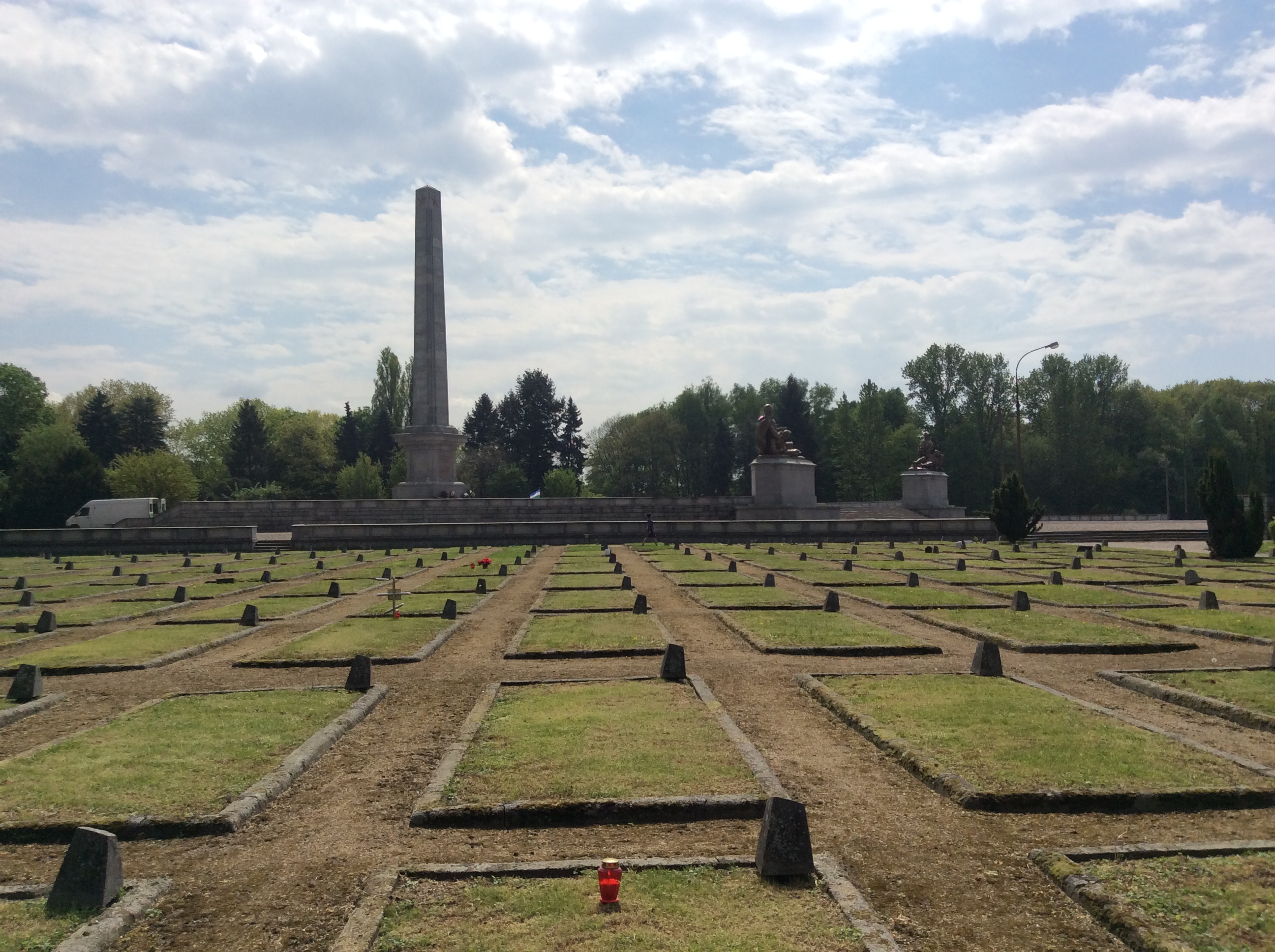
The Soviet War Cemetery in Warsaw, May 2015.

There is a sad tendency, these days, to rewrite history for political purposes.

In a recent book, French historian Philippe Richardot writes in his introduction: “The deciding factor of World War II is what occurred on the Eastern front” (my translation). And there is ample academic evidence to support this statement.

Alas, because of the current geopolitical context, in which many world leaders are opposed to Russian President Vladimir Putin, it is hard for many to resist the temptation to equate this situation with the intention of rewriting history.

Fortunately, there are people who are holding these revisionists to account.

Take for example this Israeli man who was interviewed by the Russian radio.

Here are two revealing excerpts of his interview:

“Most of the Holocaust survivors were saved by the Red Army. And they are live witnesses up until now. So it never happened in Israel anything like in Europe, nothing undermining the Russian part in the Second World War.

[…]

There are 39 memorials commemorating those who were responsible for this great victory, 39 memorials for the soldiers of the Red Army primarily. You don’t have anything like this in any other parts of the world. So today together with the Holocaust there is a memory of the great victory in Israel combined together.”

Scoring easy political points on the back of a leader you dislike is one thing, distorting history and betraying the memory of those who fell to ensure victory of barbarism and Nazism is another one. And it is unacceptable.

The Red Army deserves credit for the 1945 victory and we should never shy away from being grateful.

Remembering Jewish Soldiers of the Red Army

parade-031209According to a very interesting story published in the Jerusalem Post today, almost half of the Israelis polled are in favor of making May 9th, which is the day when Soviet Victory over Nazism is commemorated in Russia, a national holiday in Israel, too. Even more interesting is the fact that Yad Vashem (the Memorial and Museum to the memory of the victims of the Holocaust in Jerusalem) evaluates that no less than 1,5 million Jews took arms and fought barbarism during World War II. Here’s the eloquent example reported by the JPost:

“Anatoli Shapiro, for example, a Red Army officer who commanded the division that liberated Auschwitz, was the first man to open the gates and inform its prisoners ‘the Red army has come to liberate you.’ His story reflects most of all the essence of the Jewish fighters, fighters who didn’t just ask to bring freedom to Europe, but fighters who fought to save their brothers and sisters.”

There is ample academic research (you could fill a few bookshelves of books about that subject) supporting the fact that, without the USSR, it is doubtful that the Allies would have crushed Hitler’s hordes. It is no less significant to recognize the service of Jewish soldiers who were part of the Red army. On May 9th, we not only salute the Soviet (Russians, Ukrainians and others) men and women who made tremendous sacrifices, the ultimate one in the case of several millions, but also these Jewish and Israeli people who also carry that involvement as a badge of honor. A national holiday is not an exaggerated way to say: Thank you!

Israel deployed 33% of the foreign medical personnel in Nepal

Yet another representation that Israel is a people of life and for life. If you compare the importance of the various medical delegations to Nepal with the population of the involved countries, you will quickly understand that Israel’s contribution is the most significant. If you are seeking a precise number, the government of Jerusalem has deployed 33% of the foreign medical personnel in Nepal, following the earthquake.

I’m waiting for major Western news media to report on it and to stress the fact that Israel is a deeply humanitarian society and country.

But I think I’ll wait a long time to hear about it from these sources. They will wait for the next opportunity to lambast and criticize. Sad. Very sad.

Jabotinsky and Gallipoli

I just started reading Bruce Hoffman’s recent book, Anonymous Soldiers: The Struggle for Israel, 1917-1947

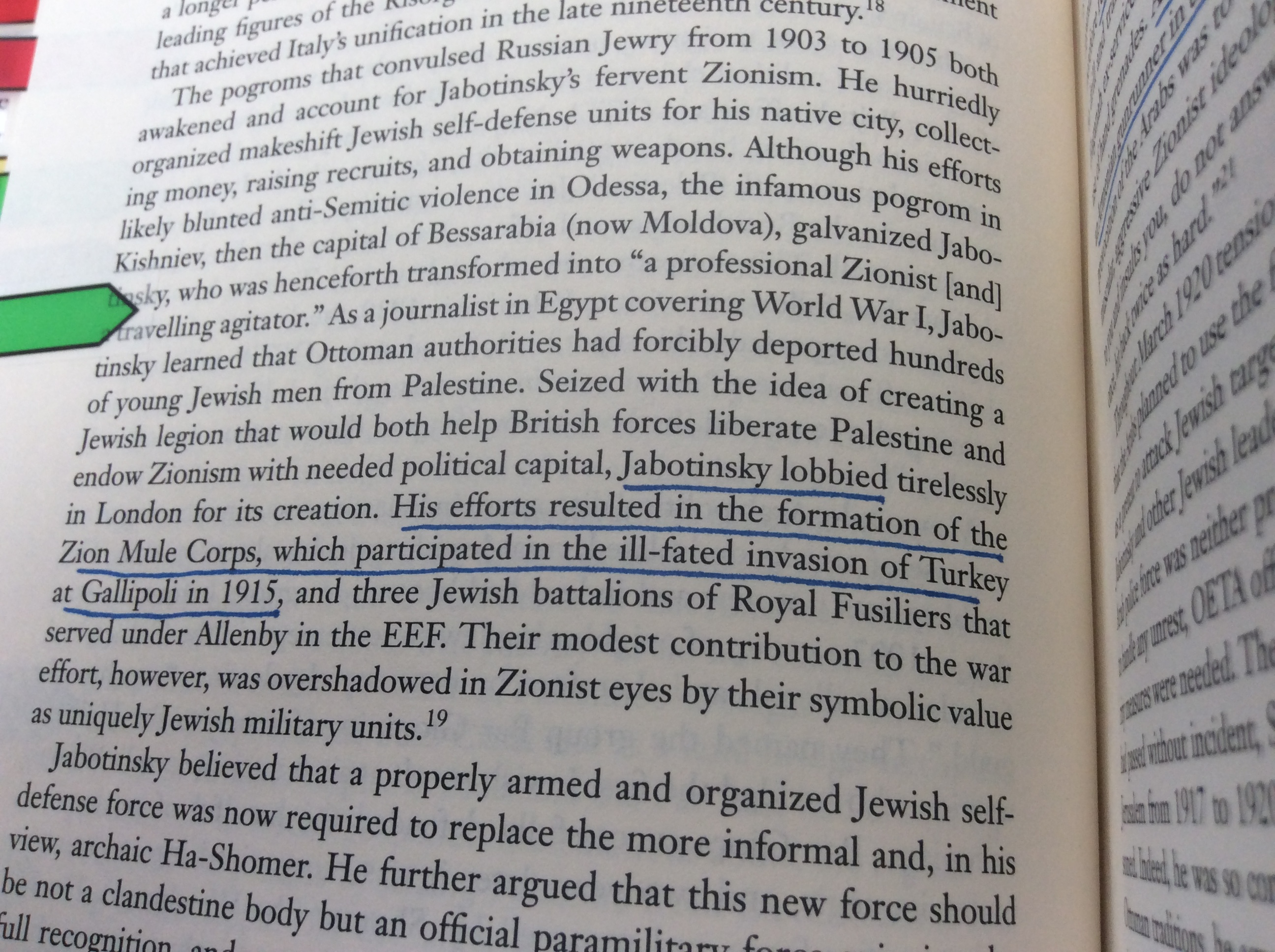
Here’s what I found on page 8: Jabotinsky

“His [Jabotinsky] efforts resulted in the formation of the Zion Mule Corps, which participated in the ill-fated invasion of Turkey at Gallipoli in 1915.”

For the record, Vladimir “Ze’ev” Jabotinsky was a Zionist leader and he was co-responsible of the creation of the Jewish Legion during World War I.

While I was aware of the existence of the Jewish Legion, I ignored the Gallipoli component of its involvement for King and Country (or, I should write Empire). Modest as this contribution might have been, it is nevertheless an excellent example that Israel – even before it was reborn under this name in 1948 – stood with the Allies (I think we can call them the West) when the going got tough.

Enough for now. I’ll publish a review of the book when I finish the last page of it. But I can already say that this is a very enjoyable read and a good investment.

The Heroes of the Israel Defense Force (IDF)

I’ve been blessed to travel to Israel on several occasions for professional purposes. Every time, I was always amazed and impressed by those young men and women who serve in the Israel Defense Force (IDF).

While other young people go to University, travel the world with friends, find a good job or establish a family, young Israelis devote an important part of their life to be on the vanguard of protecting and defending their homeland. For your information, “Males serve for three years and females for just less than two years.

So this video has it all right. It’s not a metaphor. The heroes of the IDF really have Israel’s back. And they’re the first line of defence of the values that are important for us – freedom and democracy.

RT’s article about ISIS

iraq-syria-map-isis-cnn
ISIS-occupied territory in the Middle East source: http://snipurl.com/29uu75t

I don’t know about you, but I like to read news reports and analysis from RT (Russia Today). I like their unconventional way of doing things. Their journalists sometimes irk me, but, overall, this is a very interesting News Agency. They may have an agenda, but which news media doesn’t?

All of this to say that RT reported today the revelations contained in an article from Der Spiegel with some interesting revelations supporting the fact that ISIS is an offspring of the miscalculations and mistakes of the US intervention in Iraq to remove Saddam Hussein from power.

According to RT’s article:

“The reason why ISIS are so successful as a terrorist organization is partly because many of their founding members, including the top strategist, were part of Saddam Hussein’s professional security apparatus. By shattering the well-trained army of Saddam, the US apparently created a group of very intelligent enemies.

Bakr [ISIS mastermind Haji Bakr, whose real name was Samir Abd Muhammad al-Khlifawi] was a “highly intelligent, firm and an excellent logistician,” as an Iraqi journalist described the former officer. But when the US suddenly dissolved the Iraqi army after the 2003 invasion he became “bitter and unemployed.””

Here is a powerful reminder to Western leaders and military planners that one needs to be very careful when approaching the Middle East. It’s also a reminder that we should stick even closer to our friends – lsrael being at the top of that list, but there are others like Jordan, Egypt and Saudi Arabia for example – who are our best allies to confront these threats.

They might not be perfect, but they are reliable, unlike Iran. In a context like this, a staunch friend is 100 times better than a would-be, potential, circumstantial ally.