Prigozhin’s failed putsch was essentially a sideshow

Russian President Vladimir Putin at the Kremlin on June 26, 2023 (Sputnik / Reuters)

I’m now at the age where I can say that I have observed, from afar, two coups initiated against a Russian ruler. The first one was plotted against Soviet President Mikhail Gorbachev in August 1991. The second one happened just a few days ago. I was glued to my Twitter account and CNN for most of last weekend, trying to keep abreast of developments between Rostov-on-Don and Moscow.

President Vladimir Putin being at the center of the events unfolding in these crucial hours, I believed it would be pertinent to reach out to the author of the best biography written about him to seek some insights. Philip Short, author of the seminal Putin (Holt), a book on which he worked for 8 years. Mr. Short generously agreed to answer a few questions, despite being buried under requests.

Here is the content of our discussion.

_________

Mr. Short, thank you very much for the generosity of your time.

I have a feeling that every time Vladimir Putin is referred to in the Western media, the analysis goes in the direction of his downfall – either by a coup, cancer or slipping on a banana peel. Would you tend to agree that this is wishful thinking disguised as analysis?

President Vladimir Putin’s biographer Philip Short (Macmillan)

I think we must recognize that we are in the middle of an information war that’s running parallel to the war on the ground in Ukraine. So, whether it’s wishful thinking or spin is arguable. Very often there are elements of both – added to which, western (and Russian) pundits have been pontificating very little hard information to go on, so there has been a lot of thumb-sucking of the ‘Putin’s finished’, ‘The end is nigh’, ‘Civil war beckons’, variety.

No one knows even exactly what Prigozhin was promised when he agreed to call off his mutiny. But certainly, the consensus in the Western media that Putin is severely weakened needs to be treated with skepticism. It’s just as plausible to make a case that his grip has in fact been strengthened because he found a way out which avoided the worst-case scenario of bloody fighting, and, to the elite, that is a signal that, even if he misjudged the situation early on, he hasn’t lost his touch, so ‘better to stick with the devil you know’.

Continue reading “Prigozhin’s failed putsch was essentially a sideshow”

Russian Game of Thrones

Back in March 2014, while I was sojourning in Moscow for the second time, I visited the Museum of the Great Patriotic War, the Borodino Battle Museum, and the Museum of the Patriotic War of 1812. I also took the time to drive to Zhukovo to visit the Museum dedicated to the famous Marshal – Georgy Zhukov – who vanquished the Nazis on the Eastern Front. Any serious student of history couldn’t help but note how attached the Russians are to their military heritage. It was an amazing trip for a military enthusiast like me!

To a degree that might seem astonishing to a Western mind, war occupies a fundamental place in the history of Russia. And it is imperative to fully grasp that reality, if one wants to ascertain what has been happening since February 24 in Ukraine. In that perspective, I was extremely happy to dig into Russia: Myths and Realities (Pegasus Books) by Sir Rodric Braithwaite.

I could detail all the qualities and insights of this book, but its main merit is to brush the portrait of a nation and people forged in war. “More than a thousand years ago a people arose on the territory of today’s Russia whose origins are disputed”, writes the author. “But Kievan Rus was invaded and destroyed in the thirteenth century by the Mongols.” The tone was set and even after the “Mongol yoke” was removed from Russia’s neck, the pugilistic character was well ingrained into the nation’s DNA.

Continue reading “Russian Game of Thrones”

Putin thought he could get away with the invasion of Ukraine

Giles Milton (source: Macmillan)

Giles Milton is one of my favorite authors. And it’s always a real pleasure to be in touch with him. Even before I wrote my review of his last book, he agreed to answer some questions for this blog. If you haven’t read his book yet, run to the bookstore or get it online. This is a must, in the context of the aggression war conducted against Ukraine. For the time being, I trust you will enjoy this interview.

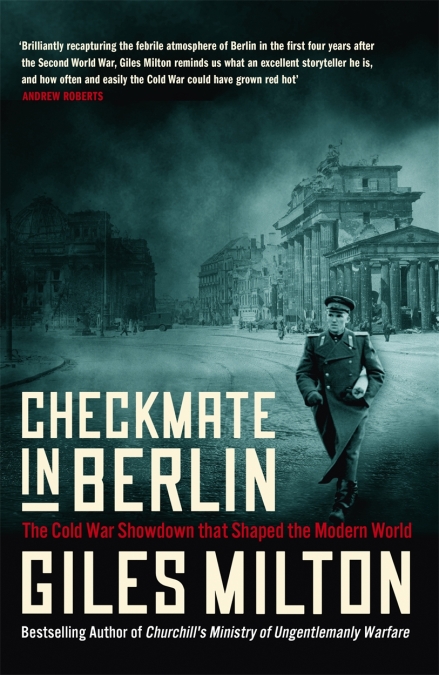
Mr. Milton, Checkmate in Berlin is a brilliant lecture about American and British innovation in adversity, mainly in organizing the Berlin airlift. Do you see the same attitude these days towards Ukraine?

Nothing on the scale of the Berlin Airlift had ever been attempted before. True, the Americans had airlifted vast quantities of weapons to the Chinese during the Second World War, but the Berlin Airlift was supporting (and keeping alive) several million Berliners.

Continue reading “Putin thought he could get away with the invasion of Ukraine”

Putin’s Soviet Playbook

As I grow older, I realize that history is one of the surest guides to navigate the present. While many adhered to Francis Fukuyama’s theory that the demise of Soviet Union on December 26, 1991, represented the end of history, others lamented what they perceived as “the greatest geopolitical catastrophe of the century”.

Old habits die hard and Giles Milton’s Checkmate in Berlin: The Cold War Showdown That Shaped the Modern World is an excellent representation of that idiom. “”America is now the primary enemy,” said one of Marshal’s Zhukov’s general at the time of the capture of Berlin. “We have destroyed the base of Fascism. Now we must destroy the base of Capitalism – America.”” Things haven’t changed much in the last 77 years.

Continue reading “Putin’s Soviet Playbook”

Will Kyiv be another Stalingrad?

Adam Zamoyski (source: History Extra)

Few years ago, around the time I visited Poland for the first time, I devoured the insightful book Warsaw 1920 by acclaimed biographer and historian Adam Zamoyski. He is also the author of a masterful book about Napoleon’s invasion of Russia in 1812. I therefore reached out to him, asking if he saw any parallel between history and the current invasion of Ukraine by Russian troops. He generously accepted to share some thoughts with me and I’m extremely grateful for that.

Here is what the acclaimed biographer of Napoleon generously shared with me:  

The parallel that struck me, weeks ago, is that with 1811-1812, when Tsar Alexander I set as his condition for maintaining his alliance with Napoleon that the French Emperor issue a formal public declaration that he would never allow the re-creation of a Polish state. This was something that Napoleon would and could not do (any more than NATO could bind itself to refusing Ukraine membership if that country wished to join).

Continue reading “Will Kyiv be another Stalingrad?”

When Khrushchev Helped JFK

Soviet leader Nikita Khrushchev and US President John F. Kennedy (source: Foreign Policy)

I recently read and reviewed an excellent biography of former Soviet leader Leonid Brejnev by Andreï Kozovoï. Even if I found it to be tragic, I was fascinated to read about Brejnev’s role in the toppling of his predecessor, Nikita Khrushchev, in October 1964. Khrushchev’s persona was light years away from the character portrayed in The Death of Stalin – it is a satire, after all – and his bombastic temper certainly played a role in his downfall.

Khrushchev always fascinated me, whether it is regarding his role during World War II, his succeeding Stalin in 1953 or his role with President John F. Kennedy (of whom we commemorate the assassination today) during the Cuban Missile Crisis in 1962. I recently came upon a very insightful article, “Nikita Khrushchev and the Compromise of Soviet Secret Intelligence Sources” in the International Journal of Intelligence and Counterintelligence by David Easter. In his research, the academic exposes several instances where the First Secretary of the Communist Party of the Soviet Union might have compromised Moscow’s intelligence work and capabilities.

Continue reading “When Khrushchev Helped JFK”

FDR: The Fearless President

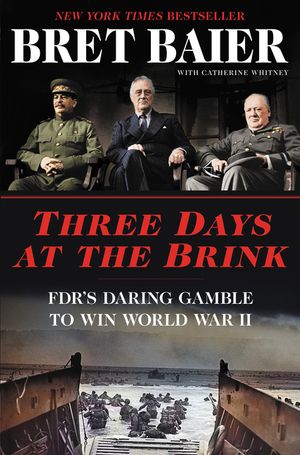
3DaysAtTheBrink_BretBaierI have always loved to read about FDR, one of my favorite Presidents. Being a fan of presidential libraries and having done some research in a few in the past, I have vivid memories of the time I spent at his inspiring Presidential Library at Hyde Park. I was therefore very interested in Bret Baier’s latest book, not only because it covers a period of contemporary history – World War II – for which I have an unquenchable intellectual thirst, but also because he dove into the presidential archives, a real treasure trove for anyone eager to fully understand the magnitude of the accomplishments of those larger than life Commanders in chief who lead America at crucial times.

The title of Bret Baier’s book Three Days at the Brink: FDR’s Daring Gamble to Win World War II refers to the Tehran Conference (1943), where the Big Three (FDR, Churchill and Stalin) agreed on the necessity to open a second front on the West – with Operation Overlord – to relieve some pressure on the Soviet troops, which occurred on June 6, 1944. But only a quarter of the book is devoted to the historic conference.

Continue reading “FDR: The Fearless President”