
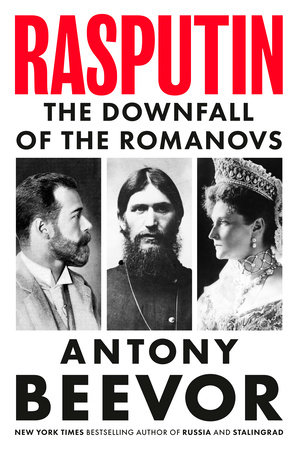
“It was the impression of Tsar Nicholas’s humiliation at the hands of his overbearing wife and the peasant Rasputin that shattered the brittle autocracy of the Romanovs.” That final line from Antony Beevor’s most recent book, Rasputin: The Downfall of the Romanovs (Viking), captures one of the most tragic collapses of a centuries-old dynasty. But how did it come about? The author, one of the most gifted writers of military history, provides the answer.
First, Nicholas II was unsuited to his “role as an autocrat. The chronic lack of confidence was matched by a longing to escape the trappings and responsibilities of power”. In the land of Ivan the Terrible, Peter the Great and Catherine the Great—and later of Stalin and Putin—that was hardly a recipe for success. Leaders can overcome their shortcomings when they are compensated for by the strengths of those around them. That is where Empress Alexandra Fyodorovna came into play—or failed to. Adept at courting unpopularity, she also contributed to the alienation of anyone outside the immediate family circle or anyone who dared disagree with her—which meant just about everyone.
In matters of decision-making, the heir to the mercurial Alexander III did not rank among the most astute either. While everyone talks about Rasputin, Antony Beevor highlights the active presence of another guru in the Romanovs’ inner sanctum: the Frenchman Philippe Nizier-Vachot. “Monsieur Philippe”, as he was known, notably encouraged “a fantasy that Nicholas really should become the ‘radiant Tsar of the East’” during a particularly tense period in Asia. The gullible Tsar embraced the idea and declared war on Japan, incapable of imagining “an Asian country resisting a major European power”. The Russians were trounced, fanning the embers of revolution.
One of the principal tasks of any absolutist regime is to ensure its own continuity. In the case of the Romanovs, that meant producing a male heir. When Alexei Nikolaevich was born on July 30, 1904, the family believed its future was secure. Bad luck—or rather bad health—intervened in the form of hemophilia. His condition became a constant source of anxiety. Empress Alexandra’s worries and fragile psychological state created the ideal conditions for a second guru, Grigory Yefimovich Rasputin, to be handed the keys to the palace, along with the family’s affection and loyalty. In short, the debauched and never-ordained monk distinguished himself thanks to his “famous ability to ease the pain of the Tsarevich, the very source of his influence over the imperial family”. The man from Siberia fully understood that “the real power lay with the Empress, not the Tsar”. The stage was set.
In calmer waters, such influence would merely have provided fodder for gossip and political intrigue. Unbeknownst to almost everyone, however, Russia was entering one of the most chaotic and consequential periods in its history—a time ill-suited to the faint-hearted or the indecisive. At the outset of the First World War, “the Tsar had wanted to name himself commander-in-chief, but his ministers and military leaders prevailed upon him to avoid such a dangerous step”. Such a move would have ensured that any military disaster could—and would—be laid directly at the Tsar’s feet.
But the Empress and the monk thought otherwise. In September 1915, Nicholas II reversed course and boarded a train to assume command at the front. Empress Alexandra urged “him to use Rasputin’s own comb to strengthen his decisions”. With her husband out of the way, she enjoyed virtually free rein to meddle in state and military affairs, aided by her benefactor. Together, they shuffled ministers as though they were cards in a deck. To the British ambassador, who attempted to warn her of the dangers ahead, she disparaged her husband, remarking that “The Emperor unfortunately is weak, but I am not”. Weak she may not have been, but she was undoubtedly detrimental to the future of the dynasty. Defeats at the front, mounting war weariness among the Russian people, and a flood of rumours and conspiracy theories turned the imperial family into the lightning rod for the nation’s failures. This toxic combination culminated in the brutal murder of the bearded consigliere and, ultimately, the firing squad in a basement in Ekaterinburg.
Events might have unfolded differently, but the man destined by birth to be the father of his country was allergic to contradictory advice and to any “criticism of Rasputin”, which only made him more obstinate. Undoubtedly, the Tsar had “no head for politics”, writes the author. At a moment that demanded leadership, he remained an unwavering devotee. To make matters worse, Nicholas II was a rabid antisemite who “firmly believed that the Jews brought pogroms on themselves”, which was far from being his least serious flaw.
Observers often repeat President Vladimir Putin’s assertion that the collapse of the USSR “was the greatest geopolitical catastrophe of the century.” As a student of history, he is certainly not immune to the lessons of the Romanovs’ brutal end. One man, Rasputin, “contributed more than any other individual” to that resounding downfall. And all he had to do was comfort the heart of power. Yet Rasputin did not bring down the Romanovs by himself. He merely exposed the weaknesses that had long threatened their survival.
_____
Antony Beevor, Rasputin: The Downfall of the Romanovs, New York, Viking, 2026, 384 pages.

