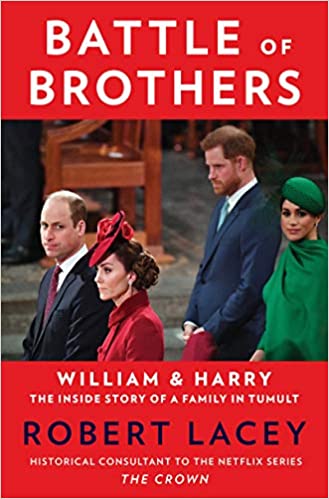
The Prince of Wales – Bouncer of the Monarchy

“‘I put my arm around my brother all our lives […], and I can’t do it any more. We’re separate entities’” Prince William once said about his relationship with his brother Prince Harry. With the release of the Netflix so-called documentary about the life of the Sussexes, media outlets report that the Prince of Wales will respond in a “swift and robust” manner to any unjust claim made by his brother and sister-in-law, whose second part will air tomorrow, December 15.

Anyone eager to know what kind of response Harry and Meghan might encounter from the principal members of the Royal family should immediately grab Robert Lacey’s enthralling and insightful book Battle of Brothers – The Inside Story of a Family in Tumult (Harper). Full disclosure, I received a review copy of this book more than a year ago. The death of Her Majesty Queen Elizabeth II prompted me to dive into it. I think the timing couldn’t be better, even though I know an updated version is available with new material.

Continue reading “The Prince of Wales – Bouncer of the Monarchy”

Le point de bascule de 1942

L’année 1942 aura toujours une signification particulière pour moi. Mon défunt père est né cette année-là, pendant la bataille de Stalingrad. Il m’a initié à la Seconde Guerre mondiale par une belle collection de livres à l’intérieur de laquelle je me suis plongé le nez très jeune. Dans leur magnifique livre 1942 (Passés / Composés), Cyril Azouvi et Julien Peltier m’ont permis de découvrir toute l’envergure et la signification de cette année « bissectrice de la guerre » pour reprendre l’expression citée et empruntée à l’historien français Henri Michel.

Pour revenir à Stalingrad, il ne devait suffire que « […] d’une seule journée pour réduire en cendres cette cité moderne et pluricentenaire » selon les plans établis par les hautes sphères allemandes. À la tête de troupes mal équipées par sa faute pour un combat hivernal, Hitler avait pourtant mal évalué le coriace adversaire qui revêtait l’uniforme du soldat soviétique et qui allait payer avec son sang les erreurs stratégiques commises par Staline au début de la guerre. Quant aux soldats portant le feldgrau, ils sortiront de la ville éponyme du dirigeant soviétique la gueule cassée et promis à une rude captivité après 6 mois et 22 jours d’une bataille dont la Wehrmacht ne parviendra pas à se relever.

Continue reading “Le point de bascule de 1942”

Boris Yeltsin and “The Crown”

Queen Elizabeth II and Russian President Boris Yeltsin (The Telegraph)

I’m watching every episode of The Crown, not only because of my love and appreciation of the monarchy in all its complexity but mainly for its entertainment value. For obvious reasons, I never take the content of the series at face value since there are many aspects which differ from reality.

Nevertheless, episode 6 of The Crown’s Season 5, titled “Ipatiev House”, brought many questions to my mind. For one, Russian President Boris Yeltsin never went to Buckingham Palace to meet Queen Elizabeth II, which makes the whole diatribe in which he insulted the Queen in Russian fictitious and potentially misleading for anyone believing that the series is an accurate portrayal of reality.

I therefore decided to ask Sir Rodric Braithwaite, Her Majesty’s Ambassador in Moscow between 1988 and 1992 and the author of an excellent recent book about the history of Russia, to shed some light on the relationship between the Crown and the two-headed eagle.

Continue reading “Boris Yeltsin and “The Crown””

The Source of JFK’s Greatness

For as long as I can remember, November 22 has always been a sobering date on my calendar. My late father, like many of his generation, revered John F. Kennedy. He owned several pieces of memorabilia. He also vividly remembered where he was and what he was doing on that fateful day when his favorite statesman tragically fell under the bullets. Before the Roosevelts, Truman, LBJ, Reagan and both Presidents Bush – commanders in chief for whom I have tons of admiration – JFK was the first one who piqued my intellectual curiosity.

I cannot proclaim that I have read every book regarding the main figure of contemporary Camelot, but I always make a point of skimming the pages of as many as I can. Mark K. Updegrove is a presidential historian whose work I have always been interested in. I was, therefore, impatient to grab a copy of his recent book Incomparable Grace: JFK in the Presidency. I was expecting a good read because the author has an enthralling writing style. But I got much more than that.

Continue reading “The Source of JFK’s Greatness”

“Putin’s war has forged Ukraine’s sense of nationhood on the battlefield”

Ukrainian soldiers (McGill University)

Two of the greatest pleasures I have as a blogger is reading the best books and being in touch with their authors. Few things make me happier than when they accept to answer a few questions for an interview.

I have always been a huge fan of Sir Rodric Braithwaite, and I was extremely happy to read and review his recent and captivating book about the history of Russia at a time when this country is at crossroads.

As a former British Ambassador to Moscow between 1988 and 1992 and a former foreign policy advisor to Prime Minister John Major, he combines the experience of a man who was on the ground when the URSS was on the cusp of exploding and the talent of an inspired historian.

I, therefore, felt extremely privileged when Sir Rodric generously agreed to answer my questions. I trust you will find his answers of tremendous interest.

___________

Sir Rodric, I’m of the school according to which great leaders make history. In that regard, I would be curious to know which Tsar or leader impresses you the most in the history of Russia and why?

The question of whether history is made by great leaders or impersonal forces will never be settled. It is the intellectual underpinning for Tolstoy’s War and Peace. In my view, you need both. Even the greatest leader cannot buck reality: Bismarck is eloquent on that.

Continue reading ““Putin’s war has forged Ukraine’s sense of nationhood on the battlefield””

The King who jeopardized the Monarchy

The cover of Prince Harry’s memoir was released last week, in mounting anticipation of the day it hits the shelves next January. Since their wedding in May 2018, Harry and Meghan have proven to be distracting – to say the least – for the Royal Family. Their staunch desire to center everything around their desires, feelings and intentions goes against the grain of an institution based on selflessness and duty.

Even though the revelations contained in his book will probably rock and ruffle Buckingham Palace, Prince Harry’s fifth position in the line of succession to the throne render his tribulations much less catastrophic than those posed by his late grandmother’s uncle, King Edward VIII. On December 10, 1936, this Monarch deposed the scepter and the orb for the sake of marrying the Queen of his heart, the American-born divorcee Wallis Simpson.

His brother, George VI, was left to pick up the pieces. He was neither supposed nor prepared to accede the throne. The reputation of the institution was severely tarnished, but the history of the world can be grateful that George Windsor was tasked with this mission because his brother David (Edward VIII)’s presence on the throne would have proved catastrophic in the period leading to and during World War II.

Continue reading “The King who jeopardized the Monarchy”

« Il y a chez cet homme du Churchill et du Clemenceau »

Le président ukrainien Volodymyr Zelensky parcourant les tranchées qui contribuent à défigurer son pays depuis le début de la guerre lancée par la Russie. (source: Kyiv Post)

Le général d’armée Henri Bentégeat est un militaire français qui a servi en tant que chef de l’état-major particulier du président de la République entre 1999 et 2002 et chef d’état-major des armées de 2002 à 2006. Il est l’auteur de deux excellents livres, Chefs d’État en guerre et Les ors de la République, tous deux publiés chez Perrin.

Je suis privilégié de le compter parmi mes interlocuteurs appréciés. Le général Bentégeat tient à conserver un devoir de réserve, pour ne pas porter ombrage à son successeur, le général Thierry Burckhart. Ce qui est très louable. Il a néanmoins accepté de partager quelques observations à propos du leadership de guerre du président ukrainien Volodymyr Zelensky.

« Qu’attend-on d’un chef d’État confronté à la guerre », de se questionner réthoriquement l’ancien proche collaborateur des présidents Mitterrand et Chirac? « D’abord, une vision claire des enjeux, ensuite une capacité à se fixer des buts de guerre ambitieux et réalistes, enfin la capacité à mobiliser l’ensemble des ressources du pays pour conduire la guerre; accessoirement, le choix de chefs militaires compétents et loyaux. Selon ces critères, le président ukrainien est parfaitement à la hauteur de ses lourdes responsabilités. »

Continue reading “« Il y a chez cet homme du Churchill et du Clemenceau »”

Russian Game of Thrones

Back in March 2014, while I was sojourning in Moscow for the second time, I visited the Museum of the Great Patriotic War, the Borodino Battle Museum, and the Museum of the Patriotic War of 1812. I also took the time to drive to Zhukovo to visit the Museum dedicated to the famous Marshal – Georgy Zhukov – who vanquished the Nazis on the Eastern Front. Any serious student of history couldn’t help but note how attached the Russians are to their military heritage. It was an amazing trip for a military enthusiast like me!

To a degree that might seem astonishing to a Western mind, war occupies a fundamental place in the history of Russia. And it is imperative to fully grasp that reality, if one wants to ascertain what has been happening since February 24 in Ukraine. In that perspective, I was extremely happy to dig into Russia: Myths and Realities (Pegasus Books) by Sir Rodric Braithwaite.

I could detail all the qualities and insights of this book, but its main merit is to brush the portrait of a nation and people forged in war. “More than a thousand years ago a people arose on the territory of today’s Russia whose origins are disputed”, writes the author. “But Kievan Rus was invaded and destroyed in the thirteenth century by the Mongols.” The tone was set and even after the “Mongol yoke” was removed from Russia’s neck, the pugilistic character was well ingrained into the nation’s DNA.

Continue reading “Russian Game of Thrones”

The khaki presidency of Volodymyr Zelensky

Serhii Rudenko (courtesy of himself)

After the publication of my review of his insightful biography of Ukraine’s President Volodymyr Zelensky, author and political analyst Serhii Rudenko generously accepted my invitation to respond to a few questions for this blog.

In the aftermath of the war launched by Vladimir Putin on February 24th, the offices of the television station where he worked became a bomb shelter. He has moved to another region, which suffered the recent Russian onslaught. The coming winter will undoubtedly be extremely difficult for Ukrainians, but Mr. Rudenko’s resilience and determination to pursue his work is immensely commendable.

I consider myself privileged to be in touch with him and to present you with the content of our discussion.

________

Mr. Rudenko, in your book, you depict an administration with a lack of political experience and a very high turnover level. Has the situation stabilized since the beginning of the war?

Yes, it has stabilized. In the conditions of war, Zelensky had to choose the most optimal and effective people. Now we see around the President of Ukraine a team that governs the state in the conditions of war. Hardly anyone in the world has such experience in governing the state. It is not easy.

Continue reading “The khaki presidency of Volodymyr Zelensky”

How Putin Saved Zelensky

The world “would hardly have heard about [Volodymyr] Zelensky if he had become an engineer, gone into the military, or became a doctor”, writes political commentator Serhii Rudenko in a recent biography of the Ukrainian President (Polity Books). Thanks to the political reality crafted by Servant of the People in which he played the role of a history teacher elected against the odds to lead the country, fiction turned into reality in 2019. And thanks to Russian President Vladimir Putin’s decision to start a war on Ukraine before sunrise on February 24th, the actor turned President has become an icon of resilience in defense of freedom and democracy.

Serhii Rudenko paints the portrait of a leader who was not on sure footing before the war intervened.

After his election, Zelensky broke his promise to distance himself from the nepotism espoused by his predecessor, Petro Poroshenko. “[…] A year after his election, the Poroshenko family was replaced by the Zelensky family – or, more precisely, by the Kvartal 95 Studio.” In other words, those who accompanied him in his showbusiness career, including in his role as President Vasily Petrovych Goloborodko on television.

Continue reading “How Putin Saved Zelensky”