The best books, their authors and the great people who inspire these stories / Les meilleurs livres, leurs auteurs et les grand.e.s de l'histoire qui les inspirent.
La présidence des États-Unis se prévaut d’une influence inégalée dans le monde. Pas une journée ne s’écoule sans que les plateformes d’informations ou de médias sociaux n’y fassent référence. Parfois, elle agace en raison de la perception véhiculée à propos de celui qui est appelé à travailler dans le Bureau Ovale. Acteur de série B, Ronald Reagan était vilipendé pour son prétendu déficit d’intellect. Idem pour George W. Bush. Mais jamais elle ne cesse de captiver. Et c’est redevable à la personnalité de ces grandes pointures qui sont parvenues à succéder aux immortels que sont devenus George Washington, Thomas Jefferson ou Abraham Lincoln.
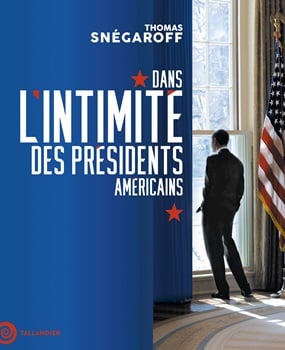
C’est justement avec ce dernier que Thomas Snégaroff débute son fascinant ouvrage Dans l’intimité des présidents américains(Tallandier). En le choisissant pour présider aux destinées de la nation, « les Américains veulent élire un homme qui leur ressemble, et surtout qui met en musique le mythe d’une Amérique des possibles. » Au-delà des prises de position et des événements cruciaux qui jalonnent l’histoire des États-Unis, l’auteur s’emploie à éclairer un aspect fondamental de chacune des personnalités alimentant les portraits esquissés, c’est-à-dire son inimité, parce qu’ « elle donne à voir, derrière les grands discours et les beaux costumes, la vérité d’un homme. »
From Pearl Harbor to the neutralization of Osama bin Laden, every US President is confronted with crises. Any one of them also needs to manage relations with foreign leaders. Hence, a need for an organized mechanism and apparatus to navigate the traffic and make sure that POTUS can take the pulse of the world at a moment’s notice. This is made possible thanks to a vital institution, whose history is brilliantly recounted by former Clinton administration official and ABC host George Stephanopoulos in The Situation Room: The Inside Story of Presidents in Crisis (Grand Central).
Before its establishment, Presidents monitored world events on an ad hoc basis. For any military history enthusiast, the depiction of Franklin D. Roosevelt’s wheelchair being pushed in a former billiard room to consult maps pinned on the walls to monitor developments unfolding during World War II is captivating. Like so many other things, John F. Kennedy would be an innovator by creating the Situation Room in light of the 1961 Bay of Pigs disaster. Every one of his successors would rely on this evolving institution to accompany the United States’ presence on the world scene.
The most important takeaway from the book relates to the notion of the “three Ps”. The Situation Room is: 1) a place where information is gathered, processed, analyzed and decided upon; 2) it regroups people who serve the Presidency in a selfless and non-partisan way and; 3) a process revealing how every commander in chief manages the affairs of the world.
Les ors de la République : Souvenirs de sept ans à l’Élysée (Perrin) a retenu mon attention parce que j’avais de très bons commentaires à propos des talents littéraires de son auteur, le Général Henri Bentégeat. Après en avoir terminé la lecture, je dois avouer que je n’ai pas été déçu. Loin de là.
Toujours intéressé par tout ce qui entoure la Res militaris, je souhaitais naturellement me renseigner davantage à propos de celui qui fut le trait d’union entre les forces armées et les présidents Mitterrand et Chirac. J’ai toujours admiré le premier et j’avais toujours cultivé une distance avec le second. Le Général Bentégeat m’a permis de rencontrer dans ses pages un personnage beaucoup plus complexe et profond que l’impression qui m’en était donnée, mais là n’est pas l’essentiel de mon propos.
À vrai dire, c’est avec délectation que j’ai sillonné les scènes du pouvoir esquissées dans le style invitant et parfois acéré de l’auteur. Pour tout dire, Mitterrand s’amuse toujours à observer les membres de son entourage conjuguer la grammaire du pouvoir. Lors d’un déjeuner avec le Sphinx (surnom donné à François Mitterrand pour sa capacité à toujours bien cacher son jeu), l’adjoint de son chef d’état-major particulier se retrouve assis à côté de lui. Voici la suite :
After the publication of my post about his recent and excellent article about the relationship between Russia and the West in the immediate aftermath of Cold War, Professor Sergey Radchenko (University of Cardiff) kindly accepted to answer few questions to examine the matter further. Here is the content of our exchange.
Having met with former Deputy Foreign Minister Georgii Mamedov when he served as Ambassador of the Federation of Russia in Canada, I am wondering if you might have more information about his role during this pivotal period in the relations between Washington and Moscow?
Mamedov is a mystery to me. He seems to have played a crucial role in the relationship, and one that was very constructive. If I were to guess at his political orientation, I would say that comes across as someone who valued Russia’s cooperation with the West and worked to bring Moscow into a closer alignment with the West. On the other hand, unlike other key figures on both sides of Russia-US relations (e.g. Talbott, Albright, Kozyrev, Primakov and others), Mamedov has not been willing to go on record with his version of events. I hope he will change his mind and we’ll get to hear his side of the story.
In your article, you oftentimes refer to the Russian elites and their impact on the policymaking about the relationship with the West. What about the American and Western elites? Did their influence play a role in the attitude towards Moscow?
The article talks a lot about the “elites,” which I guess is the same thing as what is often referred to as the “foreign policy blob” in the American context. There has recently been much discussion in the US about the role of the “blob,” as well as its vested interests (for example, in the question of US global leadership). This discussion is immediately applicable to the Russian context (and vice versa), since foreign policy of a country is really what the elites (or the “blob”) make of it. I am not being critical of the “blob” here; I just argue that there are certain narratives that are shared by the elite. In Russia’s case, it’s the narrative of their country’s international “greatness.” In the US case, it’s a question of America’s global leadership. In both Russia and the US these narratives cut across partisan lines.
The Russians have always tended to overstate the Americans’ willingness to participate in some kind of a condominium with Moscow.
The Clinton administration clearly did not seem keen on engaging Russia in the perspective of offering that country a seat at the table. Your article depicts Anthony Lake and Secretary of State Warren Christopher as being in the opposing camp of such an outcome. But were there senior officials who diverged with that assessment and who might have been more inclined to convey Russia to a greater role?
Mary Sarotte has done much more work than I have on the US side; her research shows that, indeed, there were people in the Pentagon, for instance, who were abhorred by the idea of rapid NATO enlargement. They were worried about Russia’s negative reaction and were more interested in the strategic arms control dialogue with the Russia or in Ukraine’s denuclearization. Whether this means that they were willing to give Russia a seat at the table is another matter. The Russians have always tended to overstate the Americans’ willingness to participate in some kind of a condominium with Moscow.The resurgence of the adversarial narrative, which legitimizes Putin as protector of Russia’s ‘national interests’ (defined in adversarial terms) was something that both sides contributed to.
On the Western side, you refer to Americans – of course – and to a certain extent to the Germans. I was also very interested in reading your reference to a memorandum from British Ambassador Rodric Braithwaite to Anthony Lake. How would you resume the British attitude in regards with NATO enlargement and potential Russia membership?
I have spoken to Malcolm Rifkind who was the Defense Secretary and the Foreign Secretary in the UK while this debate was going on. His position then (and now) is that Russia could never be a part of NATO, as this would undermine the very purpose of the alliance. This of course suggests that the purpose of the alliance is to keep Russia at bay, and perhaps this is how the British policy-makers viewed the problem at the time. More often, they expressed their opposition with reference to practical concerns, e.g.: how could Russia be integrated in military terms? Would this not make the alliance into another version of the OSCE?
Fundamentally, of course it was not in the immediate British interest to dilute NATO by inviting a country like Russia into the alliance, especially that the Russians claimed at the time that they have a special kind of relationship with the United States (as a key partner). This would just diminish Great Britain’s status as a key player in the West. It is interesting that in the early 1990s, the British were trying to redefine Britain’s post-Cold War role. In one of the seminars that was convened by the Prime Minister to do that, it was proposed to strive towards maintaining Britain’s status as one of the three key European powers (the others being… Germany and France). Russia was not even on the radar.
The resurgence of the adversarial narrative, which legitimizes Putin as protector of Russia’s ‘national interests’ (defined in adversarial terms) was something that both sides contributed to.
After he arrived at the Kremlin in 2000, President Putin sent signals that he was well-disposed towards the West (notably his relationship with President Bush and a visit to the Bush family summer home in Kennebunkport) – a disposition that changed over time. In your opinion, could more have been accomplished at the beginning of the Putin reign to engage further Russia with the West? It seems clear that Putin was inclined to build closer relations with the West early on in his tenure. Like Yeltsin, he expressed interest in joining NATO. I do think that an opportunity was missed to tie Russia institutionally to the West. It does not mean that Putin can evade his share of responsibility for the worsening of the relationship. It just means that, just as the article argues, the resurgence of the adversarial narrative, which legitimizes Putin as protector of Russia’s ‘national interests’ (defined in adversarial terms) was something that both sides contributed to.
The notion that Russia is part of the West is still a mainstream political view.
Are there still pro-Western advocates in the entourage of President Putin?
Yes, the two narratives that were present in the 1990s are still present, although the narrative of engagement is much less pronounced now. Putin is deeply invested in the adversarial narrative and won’t easily shift back. But were he to step down, the elites can easily shift in the other direction. No one hold deeply ideological views about Europe; if anything, the notion that Russia is part of the West is still a mainstream political view.
What would it take for Russia and the West (NATO) to get back on a more cooperative trajectory? Would it even be beneficial?
It’s tricky now because there are structural impediments (primarily, Crimea). It would be completely unrealistic to imagine that Russia will return Crimea even after Putin is gone. Re-establishing good relations between Russia and the West would thus require the West to find a viable position for itself in the Russian-Ukrainian conflict. Perhaps this would mean offering incentives to both in the context of eventual membership in both NATO and the EU. This is a far-fetched idea at the moment but the alternative to creative thinking is to simply hunker down and wait until Russia melts down. This is not a policy.
Are you currently working on a book and, if so, would you agree to lees us know what it will be about?
The book is a history of Soviet/Russian foreign policy since 1945 to the present. It’s been years in writing, and I can’t wait to finally present it to the readers! I hope it will appear in print next year.
Many sincere thanks Professor!
_____________
(version française)
« Attendre que la Russie disparaisse n’est pas une option. » – Entrevue exclusive avec le Professeur Sergey Radchenko
Dans la foulée du billet que j’ai publié à propos de votre article très perspicace sur la relation entre la Russie et l’occident immédiatement après la fin de la Guerre froide, le Professeur Sergey Radchenko (Université de Cardiff) a généreusement accepté de répondre à mes questions pour approfondir le sujet.
Ayant rencontré l’ancien sous-ministre des Affaires étrangères Georgii Mamedov lorsqu’il était ambassadeur de la Fédération de Russie au Canada, je me demande si vous pourriez nous en dire plus à propos de son rôle au cours de cette période charnière dans les relations entre Washington et Moscou.
Mamedov est un mystère pour moi. Il semble avoir joué un rôle crucial dans la relation, et un rôle très constructif. Si je devais deviner son orientation politique, je dirais qu’il s’agit d’une personne pour qui la coopération de la Russie et l’Occident était importante et qui a déployé des efforts pour rapprocher Moscou de l’Occident. D’un autre côté et contrairement à d’autres personnalités clés des deux côtés des relations russo-américaines (par exemple Talbott, Albright, Kozyrev, Primakov et autres), Mamedov n’a pas été disposé à donner officiellement sa version des événements. J’espère qu’il changera d’avis et que nous aurons accès à sa version de l’histoire.
Dans votre article, vous faites souvent référence aux élites russes et à leur impact sur l’élaboration des orientations politiques concernant les relations avec l’Occident. Qu’en est-il des élites américaines et occidentales? Leur influence a-t-elle joué un rôle dans l’attitude envers Moscou?
L’article parle beaucoup des « élites », ce qui, je suppose, est la même chose que ce que l’on appelle souvent le « blob » (la communauté washingtonienne d’experts en politique internationale selon Ben Rhodes, ancien conseiller du président Barack Obama)[1] dans le contexte américain. Il y a eu récemment beaucoup de discussions aux États-Unis sur le rôle du « blob », ainsi que sur ses intérêts particuliers (par exemple, dans la question du leadership mondial des États-Unis). Cette discussion est immédiatement applicable au contexte russe (et vice versa), puisque la politique étrangère d’un pays est vraiment ce que les élites (ou le blob) en font. Je ne critique pas ici le « blob »; Je soutiens simplement que certains discours sont partagés par l’élite. Dans le cas de la Russie, c’est celui de la « grandeur » internationale de leur pays. Dans le cas des États-Unis, il s’agit du leadership mondial. En Russie et aux États-Unis, ces discours transcendent les axes partisans.
Les Russes ont toujours eu tendance à exagérer la volonté des Américains de participer à une forme de direction à deux avec Moscou.
L’administration Clinton ne semblait manifestement pas désireuse d’engager la Russie dans la perspective d’offrir à ce pays un siège à la table. Votre article dépeint Anthony Lake et le Secrétaire d’État Warren Christopher comme étant dans le camp opposé à un tel scénario. Mais y avait-il des hauts fonctionnaires qui ont divergé de cette option et qui auraient pu être plus enclins à amener la Russie à jouer un plus grand rôle?
Mary Sarotte a travaillé le côté américain beaucoup plus que moi; ses recherches illustrent que, en effet, il se trouvait des gens au Pentagone, par exemple, qui avaient en horreur l’idée d’un élargissement rapide de l’OTAN. Ils étaient inquiets de la réaction négative de la Russie et étaient plus intéressés par le dialogue sur le contrôle des armements stratégiques avec la Russie ou par la dénucléarisation de l’Ukraine. Est-ce que cela signifie qu’ils étaient disposés à accorder une place à la Russie à la table est une autre question. Les Russes ont toujours eu tendance à exagérer la volonté des Américains de participer à une forme de direction à deux avec Moscou.
Du côté occidental, vous faites référence aux Américains – bien sûr – et, dans une certaine mesure, aux Allemands. J’ai également été très intéressé de lire votre référence à un mémorandum de l’ambassadeur britannique Rodric Braithwaite destiné à Anthony Lake. Comment résumeriez-vous l’attitude britannique en ce qui a trait à l’élargissement de l’OTAN et l’adhésion potentielle de la Russie?
Je me suis entretenu avec Malcolm Rifkind, qui était ministre la Défense et des Affaires étrangères de la Grande-Bretagne pendant que ce débat avait cours. Sa position à l’époque (et maintenant) est à l’effet que la Russie ne pourrait jamais faire partie de l’OTAN, car cela minerait la nature même de l’alliance. Cela suppose naturellement que le but de l’alliance est de tenir la Russie à distance, et c’est peut-être ainsi que les décideurs politiques britanniques percevaient la question à l’époque. Plus souvent, ils ont exprimé leur opposition relativement à des préoccupations pratiques, par exemple: comment la Russie pourrait-elle être intégrée sur le plan militaire? Est-ce que l’effet d’une telle mesure n’aurait pour effet de transformer l’alliance en une autre version de l’OSCE?
Fondamentalement, bien sûr, il n’était pas dans l’intérêt britannique immédiat de diluer l’OTAN en y invitant un pays comme la Russie, et ce, d’autant plus que les Russes affirmaient à l’époque qu’ils entretenaient un type particulier de relation avec les États-Unis (en tant que partenaire-clé). Cela ne ferait que diminuer le statut de la Grande-Bretagne en tant qu’acteur de premier plan en Occident. Il est intéressant de noter qu’au début des années 1990, les Britanniques tentaient de redéfinir le rôle de la Grande-Bretagne après la Guerre froide. Dans l’un des séminaires qui a été organisé par le Premier ministre à cette fin, il a été proposé de s’efforcer de maintenir le statut de la Grande-Bretagne en tant que l’une des trois principales puissances européennes (les autres étant… l’Allemagne et la France). La Russie n’était même pas sur les écrans radar.
La résurgence du discours antagoniste, qui légitime Poutine en tant que protecteur des « intérêts nationaux » de la Russie (définis en termes antagonistes), est un phénomène auquel les deux parties ont contribué.
Après son arrivée au Kremlin en 2000, le président Poutine a envoyé des signaux indiquant qu’il était bien disposé envers l’Occident (notamment sa relation avec le président Bush et une visite à la résidence d’été de la famille Bush à Kennebunkport) – une disposition qui a changé avec le temps. À votre avis, aurait-on pu faire plus au début du règne de Poutine pour renforcer les liens entre la Russie et l’Occident?
Il semble manifeste que Poutine était enclin à établir des relations plus étroites avec l’Occident au début de son mandat. À l’instar de Eltsine, il a manifesté son intérêt à joindre l’OTAN. Je pense qu’une occasion a été manquée de lier institutionnellement la Russie à l’Occident. Cela ne signifie pas que Poutine peut être dédouané de toute responsabilité dans l’aggravation de la relation. Cela signifie simplement que, comme l’indique l’article, la résurgence du discours antagoniste, qui légitime Poutine en tant que protecteur des « intérêts nationaux » de la Russie (définis en termes antagonistes), est un phénomène auquel les deux parties ont contribué.
L’idée selon laquelle la Russie fait partie de l’Occident est toujours une vision politique dominante.
Y a-t-il encore des partisans du discours pro-occidental dans l’entourage du président Poutine?
Oui, les deux discours qui étaient présents dans les années 1990 sont toujours présents, même si celui des tenants du rapprochement est beaucoup moins prononcé maintenant. Poutine est profondément investi dans le discours antagoniste et ne reviendra pas facilement en arrière. Mais s’il devait quitter ses fonctions, les élites peuvent facilement changer de direction. Personne n’a une vision profondément idéologique de l’Europe. Pour tout dire, l’idée selon laquelle la Russie fait partie de l’Occident est toujours une vision politique dominante.
Que faudrait-il pour que la Russie et l’Occident (OTAN) reviennent dans une trajectoire davantage axée sur la coopération? Serait-ce même bénéfique?
C’est délicat, car il y a maintenant des obstacles structurels (principalement la Crimée). Il serait totalement irréaliste d’imaginer que la Russie retournera la Crimée, même après le départ de Poutine. Le rétablissement de bonnes relations entre la Russie et l’Occident exigerait donc que l’Occident trouve une position avec laquelle elle serait à l’aise dans le conflit russo-ukrainien. Cela signifierait peut-être offrir des incitatifs aux deux dans le contexte d’une éventuelle adhésion à l’OTAN et à l’UE. C’est un scénario tiré par les cheveux pour le moment, mais l’alternative à la pensée créative est simplement de se recroqueviller et d’attendre que la Russie s’effondre. Il ne s’agit pas d’une politique viable.
Travaillez-vous actuellement sur un livre et, si oui, seriez-vous disposé à nous dire à quel sujet?
Ce livre sera une histoire de la politique étrangère soviétique / russe depuis 1945 jusqu’à maintenant. J’y travaille depuis des années et je suis impatient de l’offrir aux lecteurs! J’espère qu’il sera disponible l’année prochaine.
Merci beaucoup Professeur!
[1] Sylvie Kauffmann, « 2021, avec ou sans Donald Trump », Le Monde, jeudi 8 octobre 2020, p. 32.
Russian President Boris Yeltsin and US President Bill Clinton (Source: The Telegraph)
Russia is fascinating, Russia is dangerous. It is nevertheless important to question ourselves as to the sources of its current pugilistic conduct. Was it predestined by its history, its political DNA or could this reality have been avoided by a more efficient engagement in the past?
The Cardiff University Professor argues that in the immediate aftermath of the Cold War, the “adversarial relationship [between Washington and Moscow] was replaced with the idea of a partnership between Russia and the West but would that partnership carry enough weight to satisfy the Russian elites’ pretensions to global importance? The proof was in the pudding, and the baker was in Washington.”
In a nutshell, Russia wanted to be seated “[…] at the head of the table, right next to America’s” But Washington “[…] did not need Russia’s help in running the world, neither during the Cold War, nor, especially, in its aftermath.” After all, “[…] the world was a jungle, where the mightiest had the power of persuasion and no one listened to the counsel of the weak.”
Fast forward, Vladimir Putin has learnt that lesson and applies it in the implementation of his vision of international relations.
But let’s go back to Boris Yeltsin and Bill Clinton. There were talks about Moscow joining NATO, but no one in the West was much interested in that prospect, even though American officials dangled the possibility as bait. During that period, the embers of war inflamed former Yugoslavia and the world witnessed a vicious and murderous civil war begin in 1991. President Yeltsin “tried to make Bosnia a showcase of Russian-American cooperation.” But Washington was not interested, and Russia was “left on the sidelines”, the pride associated to her self-declared status humiliated. Much the same happened when Moscow sought to collaborate in the negotiations with North Korea’s nuclear program.
In a word, Moscow was not to be seated at the head of the table with Washington.
But by embracing enlargement without finding an appropriate role for Russia, the same [Western] policy makers overlooked the possibility that it might actually contribute to the latter’s nationalistic resurgence or, indeed, externally legitimize it. This is exactly what happened.
Pr. Sergey Radchenko
At that stage, one can sympathize with Russia’s frustration and feeling of abandonment.
Since nature abhors vacuum, “Russia’s own ontological security as a part of the West depended in large part on whether it was being recognized as such. If it wasn’t – that, too, was legitimating, because it helped the Russian political elites find their ground in an uncertain world, if not as friends, then at least as adversaries of the West.”
Professor Radchenko brings some nuances to that point of view, when he writes that “[…] one can of course lament Russia’s exclusion from Europe as a deliberate act of policy but it is hard to deny that such exclusion was partly justifiable in view of Russia’s own policies [like, for example, the war in Chechnya] […].”
Russia sought “legitimation through an adversarial relationship”, while the United States refused to offer “[…] enough leeway for legitimation through a genuine and inclusive partnership.” The seeds of confrontation had been planted by efficient gardeners. “It is hard to blame the White House”, writes the author. “They were the realists. But by being too realistic and not sufficiently idealistic at a time when they could have made a difference, they helped make Russia’s imperialist resurgence a self-fulfilling prophecy.”
As a student of history, I would bet that a discreet apparatchik named Vladimir Putin took careful notes and vowed not to fall into the idealist trap if his time came. And it came.
Russia certainly is not faultless in the current international context. But one can wonder what could have happened if the Clinton administration had adopted a different posture. In the land of “what ifs”, anything is possible, and I am not fond of revisionism. But one can easily assume that humiliating someone is never a good insurance policy for future good relations.
You can’t change the past, but there is always hope for the future. Russia is not immune to good relations with the United States. Vladimir Putin was the first international leader to call and offer assistance to President George W. Bush after the horrendous terrorist attacks on 9/11 and he was among the first ones to wish a speedy recovery to Donald Trump after news broke that the US President had tested positive to Covid-19.



 BookMarc