
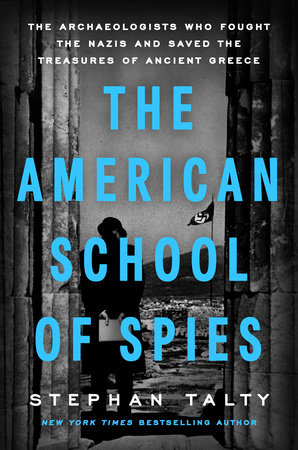
The pleasure of reading about World War II through the lens of the Greek theatre is seldom found on bookstore shelves. I was therefore thrilled to discover The American School of Spies: The Archaeologists Who Fought the Nazis and Saved the Treasures of Ancient Greece (Dutton) by Stephan Talty. Little did I know when I started that I was about to discover one of the most fascinating stories I have ever read about the convergence of history, academia, and espionage.
The author reminds us that Adolf Hitler’s chief theorist, Alfred Rosenberg, “was hopeful that his men, led by the famous Nazi archaeologist Hans Reinerth, would pull from the ground “pre- and protohistoric Germanic and Slavic finds” that would at long last prove the connection between ancient Greece and the early Germans.” The occupation of Greece proved to be anything but pleasant. According to the author, approximately 5 percent of the population would not survive it. It would also provide the Feldgrau Horde with ample opportunities to seek out the alleged—and entirely imaginary—bridge between the civilization that gave birth to democracy and the warped minds that sought to appropriate its legacy for their own purposes.
Enter William “Wild Bill” Donovan, the former Wall Street lawyer and larger-than-life character whom President Franklin Delano Roosevelt tasked with creating the Office of Strategic Services (OSS), the ancestor of the CIA, an intelligence organization designed to help win the war in the shadows. In 1942, Rodney Young, an archaeologist in his thirties who had been assistant director of the American School in Athens, was given a mission. He knew the Greek landscape well, not least from his wartime efforts to reach and assist local populations: following the German invasion, he had found a way to acquire an ambulance to help those in need. As head of the Greek Desk, he would recruit classicists and teach them the art of spycraft “in order to save Greece and its ancient relics”. A Herculean task.
Over a period of six months, an effort was undertaken to hide and bury as many artifacts as possible — until the war was over. From museum directors to private citizens, everyone shouldered this all-encompassing effort, bearing in mind that “the Germans couldn’t covet what they couldn’t see”. They were still able to lay their hands on many treasures of Ancient Greece, some of which were never recovered despite the efforts made after the war. Still, the large-scale operation deprived them of numerous spoils they had coveted.
After “the Germans marched into Athens on April 27, 1941”, the local population had to cope with the reality that “German soldiers turned the famous Temple of Poseidon into a fortress and installed eight machine guns”, among other such grim sights, while enduring the travails of occupation and the starvation that came with it. With bravery and resilience, their spirit of resistance was bolstered by the presence of another group trained and sent by “Wild Bill” Donovan. “The OSS commander has pursued the idea of recruiting young Greek American commandos who spoke the native language and were intimately familiar with the culture – men who were also, presumably, ready and willing to kill the occupiers of their ancestral homelands.” Jack Ryan walked in Homer’s footsteps.
Sometimes recklessly, the commandos accomplished their mission with gallantry. In that regard, one of the most touching stories is that of Dorothy Cox, whose “brief was to supply Allied military strategists and policymakers with Greek intel, she was also expected to help the Desk’s spies get up to speed” from an apartment in Izmir, Turkey. At some point, her humanitarian side led her to take “twenty-five hundred dollars (about forty-five thousand dollars today) from her own personal funds and cadged thirty-five hundred dollars from friends” to procure relief for the Greek population. She was never reimbursed.
As newcomers to the dark arts of espionage, the Americans lacked the same level of experience, and a rivalry soon emerged between them and their British counterparts. It was fueled largely by London’s ambitions for Greece. Situated at the crossroads of its interests in the Balkans and towards India, Greece was too important for Winston Churchill to contemplate any loss of influence or the prospect of a communist government; he therefore sought the restoration of the monarchy.
As a keen student of geopolitics, Rodney Young “foresaw that Greece would become a pressure point in the postwar world, and he wanted American eyes and ears on the ground”. The State Department was receptive, but FDR refused to stray from Alliance politics. The British Prime Minister, who “made a surprise detour to Athens” on his way back from Yalta, had his way, at least for a time. Britain’s decline in world affairs, however, was inevitable. Washington would eventually take the driver’s seat, and its Marshall Plan would help stabilize Greece’s economy in the context of the civil war that raged between 1946 and 1949.
Through Stephan Talty’s masterful storytelling, The American School of Spies is much more than a narrative of war, espionage, and special operations. It is the story of exceptional men and women who answered the call to defend Western civilization’s most treasured artifacts and values, preserving them—and the ideals they embody—in the face of tyranny. With Christopher Nolan’s The Odyssey bringing Homer’s epic back into the cultural spotlight, Talty’s story offers a striking reminder that the ideals of ancient Greece are not confined to myth or antiquity. In their incomparable way, they were the true disciples of The Odyssey’s Telemachus. Could we do the same?
_____
Stephan Talty, The American School of Spies: The Archaeologists Who Fought the Nazis and Saved the Treasures of Ancient Greece, New York, Dutton, 2026, 320 pages.

