
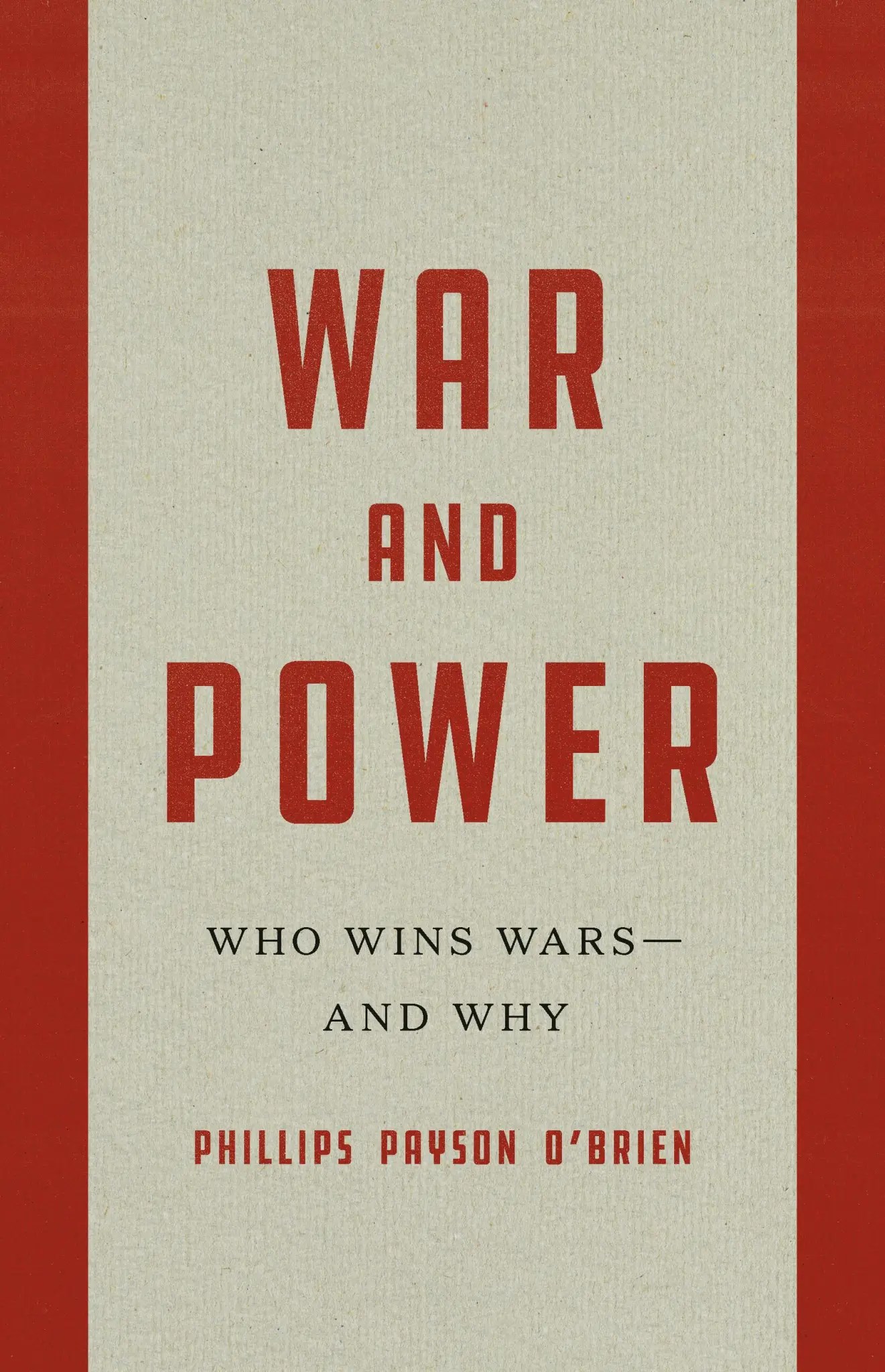
The fate of war is sealed long before the sound of cannons fills the air. That is the conclusion I reached after reading Phillips Payson O’Brien’s latest book, and it recalls Sun Tzu’s teaching that victorious warriors win first and then go to war.
The argument resonates in a particular way when viewed against the backdrop of a news report according to which “the U.S. Army has significantly depleted its stockpile of highly accurate long-range missiles” (The Independent). Not necessarily the strongest posture from which to engage a determined enemy. “Going back to the great invasion of Greece by the Persian emperor Xerxes in 480 BCE (sometimes referred to as his second invasion), it can be seen how the largest and most powerful military forces can be crippled by the lack of supply”, writes the acclaimed historian in War and Power: Who Wins Wars and Why (PublicAffairs).
Before and beyond the clashes of iron and blood, “war is a test of various systems in a multitude of different ways; it is not a test of armies, and certainly not something that is determined by supposedly decisive battles”. Societies must therefore be willing to sustain the financial, industrial, and moral investments required to prevail when called upon. Alas, “instead of investing in their militaries, western European countries [to which we could add other countries, like Canada] have prioritized their vast welfare states”, as observed by former Senior National Security Adviser to the Australian government John Lee in a recent Foreign Affairs article. Such choices carry a cost—not only for national resources, but also for long-term strategic credibility.
Since the beginning of the Russian invasion more than four years ago, Ukrainians have demonstrated remarkable grit and ingenuity. Yet one may question whether similar levels of societal endurance could be expected in many advanced democracies that have grown increasingly detached from the realities of prolonged conflict. Morale remains a decisive factor in war, and the historian points out that “in the case of Vietnam, perhaps the greatest factor that led to the American defeat was that US society eventually decided that the war was unwinnable, even after the expenditure of massive amounts of money and the deaths of many American soldiers.” The question, therefore, is whether our societies could sustain the demands and sacrifices required by a long war. The reactions whenever energy prices rise because of events in the Strait of Hormuz offer a revealing indication of how difficult sustaining such commitment could prove.
“There is only one thing worse than fighting with allies, and that is fighting without them,” declared Winston Churchill. “Most wars are won and lost by coalitions”, observes Phillips Payson O’Brien. Drawing on his encyclopedic knowledge, he reminds the reader that “Sparta’s cooperation with the Persian Empire, for instance, was crucial to its triumph over Athens”. At times, the gulf between the wisdom of the Ancients and the reading habits of some statesmen is immense. Yet China faces a significant disadvantage compared with the United States, whose network of alliances remains one of its greatest strategic assets.
Yet the balance shifts in another, arguably even more important, domain: industrial capacity. He emphasizes that, during World War II, “Britain’s ability to mass-produce weapons in all classes helped it stand apart from almost all the other powers, including Germany, during the war. Though people do speak of Germany being a larger power, that was true only in terms of soldiers.” By that measure, China now occupies a commanding position, having become “the largest shipbuilding country in the world, [while] the American domestic shipbuilding industry has all but disappeared”. In many quarters and from a North American perspective, this imbalance is deeply concerning.
There are reasons for cautious optimism for the West. By adopting a military strategy aimed at building the strongest conventional army in Europe, Germany has recently signalled a decisive break with decades of strategic complacency. Whether the Bundeswehr will have sufficient time and personnel to realize this ambition remains an open question. Even so, the book convincingly argues that “in most major wars it is not what you start with that decides the contest; it is what you make during the war that determines the military outcome”. The strategic imperative could not be clearer.
In previous works, the oracle of the University of St. Andrew’s has devoted substantial time and attention to President Franklin D. Roosevelt, and War and Power is no exception. He analyzes how the president, who focused on building naval vessels and airplanes, “was the world’s greatest practitioner of what might be called industrial/political warfare – using machines to control the movements of supplies and goods around the world, while using soldiers as little as possible.” FDR understood that victory depended not only on battlefield performance but on the ability to mobilize an entire economic and industrial system in support of war aims. He also demonstrated the importance of strategic diplomacy by helping forge an improbable but ultimately victorious coalition with Churchill and Stalin. Beyond the war itself, the Squire of Hyde Park showed remarkable foresight in recognizing China’s future rise as a global power.
History remains an unparalleled guide to understanding how wars must be anticipated and prepared for. Before the first shot is fired, the sinews of victory or the seeds of defeat have often already been laid by those who respect its enduring laws and those who disregard them. This is the profound lesson at the heart of this masterful work.
Payson O’Brien’s book already ranks among my favourite reads of 2026.
_____
Philipps Payson O’Brien, War and Power: Who Wins Wars and Why, New York, PublicAffairs, 2025, 288 pages.

