
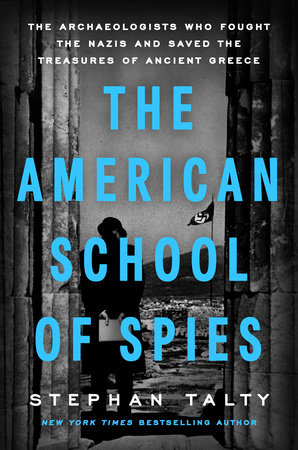
The pleasure of reading about World War II through the lens of the Greek theatre is seldom found on bookstore shelves. I was therefore thrilled to discover The American School of Spies: The Archaeologists Who Fought the Nazis and Saved the Treasures of Ancient Greece (Dutton) by Stephan Talty. Little did I know when I started that I was about to discover one of the most fascinating stories I have ever read about the convergence of history, academia, and espionage.
The author reminds us that Adolf Hitler’s chief theorist, Alfred Rosenberg, “was hopeful that his men, led by the famous Nazi archaeologist Hans Reinerth, would pull from the ground “pre- and protohistoric Germanic and Slavic finds” that would at long last prove the connection between ancient Greece and the early Germans.” The occupation of Greece proved to be anything but pleasant. According to the author, approximately 5 percent of the population would not survive it. It would also provide the Feldgrau Horde with ample opportunities to seek out the alleged—and entirely imaginary—bridge between the civilization that gave birth to democracy and the warped minds that sought to appropriate its legacy for their own purposes.
Enter William “Wild Bill” Donovan, the former Wall Street lawyer and larger-than-life character whom President Franklin Delano Roosevelt tasked with creating the Office of Strategic Services (OSS), the ancestor of the CIA, an intelligence organization designed to help win the war in the shadows. In 1942, Rodney Young, an archaeologist in his thirties who had been assistant director of the American School in Athens, was given a mission. He knew the Greek landscape well, not least from his wartime efforts to reach and assist local populations: following the German invasion, he had found a way to acquire an ambulance to help those in need. As head of the Greek Desk, he would recruit classicists and teach them the art of spycraft “in order to save Greece and its ancient relics”. A Herculean task.
Continue reading “When Homer Meets Jack Ryan”
 BookMarc