Putin is following Hitler’s blueprint

I started reading Poland 1939: The Outbreak of World War II by historian Roger Moorhouse last summer, with the intention of reviewing it on the 82nd anniversary of the tragic events that unfolded in September of that fateful year. But life caught up with me and the book remained unfinished on my desk for several months. That was until Vladimir Putin decided to invade Ukraine.

Let me start with an observation. Not much – not enough I should say – is written in English about Polish military history. I remember reading Adam Zamoyski’s Warsaw 1920 in 2012, when I first visited Poland. During that trip, I also visited the Field Cathedral of the Polish Army and the Warsaw Uprising Museum, both located in the capital city. Notwithstanding these contacts with Polish military history, I always have the image of Polish lancers attacking the mighty Wehrmacht in a useless charge.

Continue reading “Putin is following Hitler’s blueprint”

Heeding Wellington’s Advice

Dr. Seth G. Jones (source: CSIS)

In the aftermath of my review of his excellent book, Three Dangerous Men: Russia, China, Iran and the Rise of Irregular Warfare, its author Dr. Seth G. Jones accepted to answer my questions. Our exchange occurred before the start of the invasion of Ukraine. With cyber warfare at the disposal of current armies – like the crashing of the Kremlin website today – the content of this insightful book is ever more pertinent. And Dr. Jones is the best specialist to better understand this new way of conducting war.

Here is the content of this fascinating exchange.

Valery Gerasimov has been an avid student of U.S. military campaigns.

Dr. Jones, in Three Dangerous Men, one of the things I found most interesting was the reading habits of Russian General Valery Gerasimov. Apart from devouring tomes about Russian military doctrine and history, do you know if he is also interested in learning about Western figures and military episodes?

Valery Gerasimov has been an avid student of U.S. military campaigns. He closely studied U.S. operations in Bosnia, Kosovo, Afghanistan, Iraq, Libya, and other countries. Gerasimov concluded that the United States had moved away from what he called the “traditional” approach to warfare and toward a “new,” more clandestine approach, which he termed a “concealed use of force.” Gerasimov’s study of the United States was instrumental in evolving Russia’s own military doctrine, strategy, and tactics—including its use of irregular warfare.

Continue reading “Heeding Wellington’s Advice”

The bookworm, the martyr, and Xi’s longtime friend

War adapts itself and evolves. While some may take comfort in the fact that conventional battles are most likely a phenomenon of the past, the wisdom that guided those who won them is crucial to inform us about how to efficiently carry the fight from now on.

I recently reviewed the insightful novel 2034 by Admiral James Stavridis about a potential future war between China and the United States, during which China’s People’s Liberation Army takes advantage of technology to defeat the US Navy. Anyone watching the news can grasp that the rivalry between Beijing and Washington could lead to a hot war in the future, even if the author of the novel – a man who forgot more about polemology than any of us will ever learn – evaluates that the risks are feeble, the need to be prepared is nevertheless crucial.

Continue reading “The bookworm, the martyr, and Xi’s longtime friend”

“Overall, 2021 has been a difficult year for the Biden team” – Admiral James Stavridis

Admiral James Stavridis USN (Ret.) (source: US Naval Institute)

Before the Holidays, Admiral James Stavridis USN (Ret.), one of my favorite authors, granted me an end of year interview about issues related to his amazing novel 2034 about a war between China and the United States. These geopolitical issues are unlikely to disappear from the radar in the coming months and years. The Admiral’s insights are therefore not only very informative, but also crucial to grasp the state of the world.

Admiral Stavridis, I’ve read and reviewed 2034: A Novel of the Next World War (Penguin Random House) with tremendous interest. Before we head into more serious stuff, a question burns my tongue. Since there are lots of mention of the delicious M&Ms throughout the novel, I was wondering if you are a fan of that candy yourself and if that’s the reason why it is mentioned in the book?

While I am not personally a fan of M&M candies, I have known many sea-going naval officers who are. I liked the idea of Lin Bao [one of the main characters of 2034] enjoying an American candy, essentially a nod to the duality of his upbringing.

Continue reading ““Overall, 2021 has been a difficult year for the Biden team” – Admiral James Stavridis”

Is Putin a Weak Strongman?

22 years ago, tonight, Vladimir Putin ambled in history and became President of Russia after Boris Yeltsin retired. Since then, many have spent countless years scrutinizing his every moves. In a sense, the new master of the game largely contributed to Kremlinology’s survival as a discipline. And the prospect of him seeking another term in two years means that Putinology still has bright days ahead. His exercise of power remains one of the most fascinating questions to any student of Russian politics.

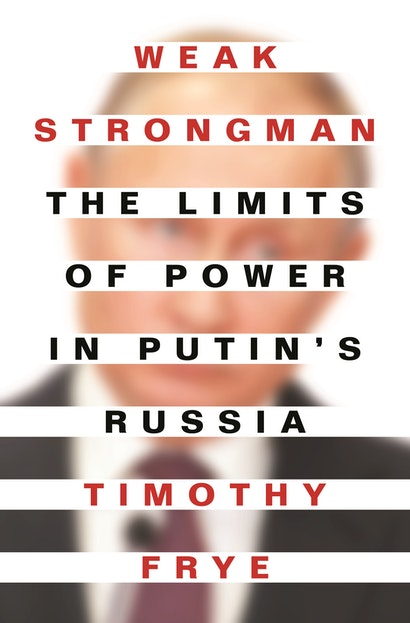
I just finished reading a most excellent book about the Russian President, Weak Strongman: The Limits of Power in Putin’s Russia by renowned Columbia University Professor Timothy Frye. In a documented, clear, and eloquent style, the main conclusion of the author is that Vladimir Putin’s main political quality is his ability to navigate the stormy seas of Russian politics.

Continue reading “Is Putin a Weak Strongman?”

When Khrushchev Helped JFK

Soviet leader Nikita Khrushchev and US President John F. Kennedy (source: Foreign Policy)

I recently read and reviewed an excellent biography of former Soviet leader Leonid Brejnev by Andreï Kozovoï. Even if I found it to be tragic, I was fascinated to read about Brejnev’s role in the toppling of his predecessor, Nikita Khrushchev, in October 1964. Khrushchev’s persona was light years away from the character portrayed in The Death of Stalin – it is a satire, after all – and his bombastic temper certainly played a role in his downfall.

Khrushchev always fascinated me, whether it is regarding his role during World War II, his succeeding Stalin in 1953 or his role with President John F. Kennedy (of whom we commemorate the assassination today) during the Cuban Missile Crisis in 1962. I recently came upon a very insightful article, “Nikita Khrushchev and the Compromise of Soviet Secret Intelligence Sources” in the International Journal of Intelligence and Counterintelligence by David Easter. In his research, the academic exposes several instances where the First Secretary of the Communist Party of the Soviet Union might have compromised Moscow’s intelligence work and capabilities.

Continue reading “When Khrushchev Helped JFK”

The Day Zhukov Danced

After German Field Marshal Wilhelm Keitel signed the articles of surrender on May 9th, 1945, “Soviet officers shook hands with their allies from the west.” World War II was officially over, and a festive spirit descended upon the victors. “Vodka and champagne flowed, freely, and buoyed by the joyous atmosphere, [Soviet Marshal] Zhukov even performed a Russian folk dance on the parquet floor of the officers’ mess.”

Passages like those abound in Volker Ullrich’s most recent book Eight Days in May: The Final Collapse of the Third Reich (Liveright). Between the covers of this absorbing and sometimes revolting book, the reader is immersed in the tragic hours when the grandees of the Nazi horde maneuver to cling to power under the leadership of Admiral Karl Dönitz, while trying to save as many German soldiers as possible from the advancing Russian soldiers who are – legitimately, one could say – thirsty for “revenge and retribution”.

Continue reading “The Day Zhukov Danced”

“Good strategy might just be staying out of trouble” – Exclusive interview with Sir Lawrence Freedman

Sir Lawrence Freedman (credit: Boston Consulting Group)

Sir Lawrence Freedman is not only an internationally acclaimed author, but he is also the dean of British strategic studies and Emeritus Professor of War Studies at King’s College London. I have a boundless admiration for this institution and I hope to enlist in the near future to the online Master’s Degree in War Studies it offers.

Sir Lawrence generously accepted to answer a few questions for this blog and I am extremely grateful for that. Here is the content of our exchange.

Russia is a constant challenge because it feels itself at threat from the West and has taken a tough stance that creates an edginess.

My point was then that the withdrawal from Afghanistan, chaotic though it was, was unfortunately expected and the lesson (not to put substantial ground forces into a civil war) had been learned a decade earlier. Russia is a constant challenge because it feels itself at threat from the West and has taken a tough stance that creates an edginess, especially as it plays a disruptive role in European affairs. It poses a challenge that is serious but should be manageable as its underlying position if weak. China has been getting stronger for the past three decades year on year, although that growth may be stuttering now. It has turned itself into a great power, militarily as well as economically, and under Xi has taken a much more assertive stance on a whole range of issues. I believe this stance will turn out to be counter-productive, but it creates a risky and dynamic situation which could spark a wider confrontation (see answer to next question).

Continue reading ““Good strategy might just be staying out of trouble” – Exclusive interview with Sir Lawrence Freedman”

Vladimir Putin, campaign manager

A few years ago, I was captivated by Peter Schweizer’s book Reagan’s War: The Epic Story of His Forty-Year Struggle and Final Triumph Over Communism. That fascinating book detailed how the 40th President of the United States used the economic weaknesses of the USSR to bring it on its knees, notably with the help of the Saudis regarding the oil price and the military build-up with which Moscow could not compete with Washington.

Turns out that, while the USSR crumbled, a young KGB lieutenant colonel named Vladimir Putin took good note.  In a recent interview with a former Soviet official, my interlocutor spoke to me about the Russian President’s love of judo – his favorite sport – and the transposition of its techniques in politics. The master of the Kremlin’s dealings in world affairs is a good illustration of his abilities to take advantage of his opponents’ weight to knock them down.

Nowhere is this ability more evident than in the pages of British journalist Luke Harding’s book Shadow State: Murder, Mayhem, and Russia’s Remaking of the West (Harper). In a real page-turner, the author details how the Russian government and its entities are influencing the West’s political life. For example, using Novichok as a calling card in attempting to neutralize Sergei Skripal, a former Russian intelligence officer who betrayed the GRU (The Main Directorate of the General Staff of the Armed Forces of the Russian Federation). Or shabby dealings using banks allegedly to bail out influential people – allegedly like former US President Donald Trump. Moscow is determined to go to any lengths “[…] to return to a nineteenth-century model of great-power politics and to disrupt the ideals-based international order established after the Second World War […].”

Continue reading “Vladimir Putin, campaign manager”

Putin was certainly quite pro-Netanyahu

Russian President Vladimir Putin and then-Prime Minister Benjamin Netanyahu (source: The New York Times)

In his last speech as Prime Minister of Israel last Sunday, Benjamin Netanyahu evoked his proximity with President Vladimir Putin the following way:

“We developed special relations with Russia, not just with Russia as a state, we also nurtured a direct close line with the president of Russia. And in so doing, we guaranteed the freedom of maneuver of the Israeli Air Force in the skies of Syria in order to prevent Iran entrenchment on our Northern border.”

A news outlet stressed the fact that the former Prime Minister of Israel “[…] boasted of his friendship with Putin and was a frequent guest in Russia.

I have always found the closeness between Putin and Netanyahu to be extremely interesting, not to say simply fascinating. Notably in the context of the increasing presence of Russia in the Middle East.

Continue reading “Putin was certainly quite pro-Netanyahu”