
Cliquez ici pour la version française
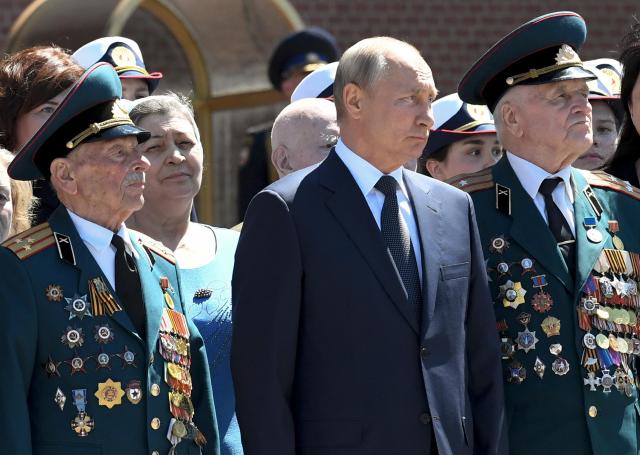
In just a couple hours, the heart of Russia will vibrate to the sound of patriotic military music. People will celebrate Victory Day and the 75th anniversary of the defeat of Nazi Germany – a feat that would have been impossible without Soviet contribution. President Vladimir Putin will be the host of the ceremony that will unfold in Moscow. Since he has been at the helm of Russia for 20 years and because it is realistic to think that he will carry on beyond the end of his current mandate in March 2024, I thought it might be interesting to conduct an interview about the President of the Federation with a leading expert of this country. Dr. Dmitri Trenin, author of many insightful books on the subject (I recently reviewed his captivating book about the history of Russia) and Director of the Carnegie Moscow Center, has generously accepted to answer my questions. Here is the content of our exchange.
Putin has broken the American monopoly in world affairs.
Entire forests have been used to print analysis and op-eds condemning President Putin and portraying him as a threat to the world’s stability. On the other side, your book about the history of Russia presents him as a leader who wants his country to be respected. What is his worldview and agenda?
What you say depends on where you sit. For those defending the current – post-Cold War – order of unprecedented dominance of the United States and the liberal and democratic norms that the U.S. has established – upholds and polices, Vladimir Putin is a dangerous disruptor. Since his Munich speech of 2007, he has been publicly challenging U.S. global hegemony and since 2008 (pushing back against Georgia’s attempt to recover breakaway South Ossetia) and 2014 (intervening in Crimea and Eastern Ukraine) has been pushing back against Western geopolitical expansion. Putin has broken U.S. de facto monopoly on intervening in the Middle East by sending forces into Syria in 2015. The following year, Russia interfered with its information resources in U.S. domestic politics which stunned many Americans who are not used to foreigners seeking to influence them. Russia has also strengthened partnership with China, America’s principal challenger of the day. Moscow has energy assets in Venezuela, whose leadership Washington seeks to topple; it has a relationship with Iran and contacts with North Korea, two minor enemies of the United States. Above all, however, Russia, under Putin, has veered off the West’s political orbit; returned to the global scene as a great power; and rebuilt its military might. Russia, which had been relegated to yesterday’s news, an international has-been, a regional power at best (Obama) and a filling station masquerading as a country (McCain), made a stunning comeback.
Continue reading “Vladimir Putin, Defender of Russia’s Interests”
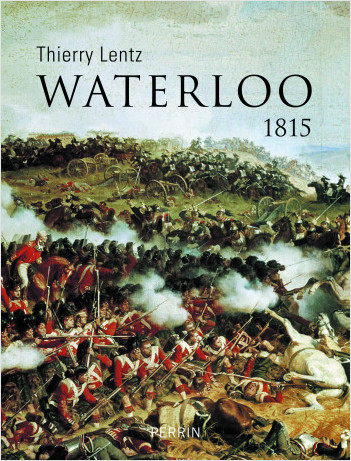 L’été 2014 fut le plus beau de ma vie, en ce qu’il m’a offert le privilège de visiter une multitude de champs de bataille et lieux historiques sur le continent européen. De ceux-ci, Waterloo figurait en tête de liste. Ayant toujours nourri un vif intérêt envers le Duc de Wellington, j’étais fasciné de passer une bonne heure dans ce que fut son quartier général à l’époque (et qui porte maintenant le nom de Musée Wellington).
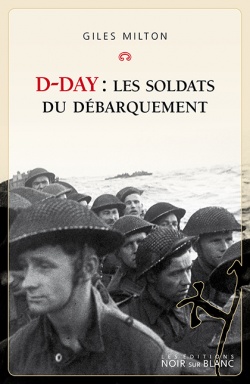 Je me suis souvent posé la question à savoir comment se sentaient les soldats qui ont été parachutés et qui sont débarqués en Normandie dans le cadre de l’Opération Overlord. À la fin de l’été 2015, j’ai eu l’immense privilège de fouler le sable de Juno Beach, le secteur canadien du débarquement. Après la visite d’une position fortifiée, nous nous sommes dirigés sur la plage avec notre guide. J’ai alors été envahi d’un double sentiment. Je ressentais d’une part une très grande fierté de savoir que les bottes canadiennes ont traversé ce sol sacré pour libérer l’Europe de la horde brune. D’autre part, je ne pouvais m’empêcher de me demander comment ces hommes se sentaient au moment d’accomplir le destin auquel leur dévouement les appelait.
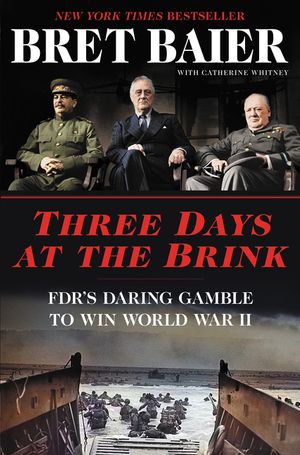 I have always loved to read about FDR, one of my favorite Presidents. Being a fan of presidential libraries and having done some research in a few in the past, I have vivid memories of the time I spent at his inspiring Presidential Library at Hyde Park. I was therefore very interested in Bret Baier’s latest book, not only because it covers a period of contemporary history – World War II – for which I have an unquenchable intellectual thirst, but also because he dove into the presidential archives, a real treasure trove for anyone eager to fully understand the magnitude of the accomplishments of those larger than life Commanders in chief who lead America at crucial times.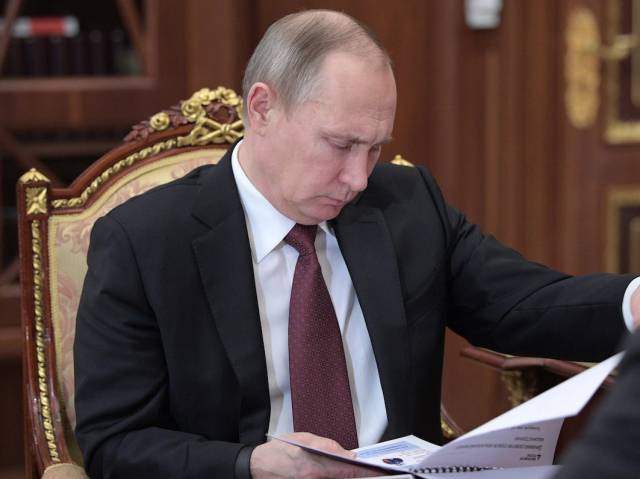
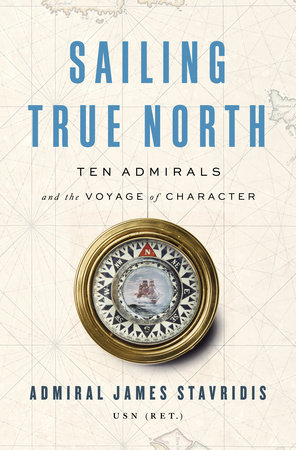 Sea Power has always fascinated me. I will forever cherish the memories of walking in the footsteps of Admiral Chester Nimitz in Pearl Harbor and Admiral Horatio Nelson at Gibraltar. Back in 2011, I spent a night on the Rock and had trouble sleeping. Heat certainly had something to do with it, but I was also pondering how the British legend spent his days here, defending the interests of King and Country at the entrance of the Mediterranean Sea. I like to think that I might have crossed his spirit while walking in the beautiful streets of this British Overseas Territory.
 Few years ago, while visiting in Italy, I booked a talented guide to visit Monte Cassino and its vicinity. As I left the train, upon arriving in the bucolic town whose name is associated to one of the most famous battles of World War II, I was struck by the breathtaking landscape. Up above a steep mountain, the famous Benedictine Abbey lays towering over the surrounding valley.
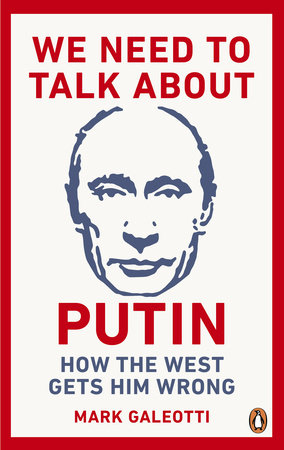 On page 22 of your excellent book about President Putin, you write “If people think you are powerful, you are powerful.” On page 53, you refer to “purposeful theatricality”. In your book, Putin doesn’t come across as a bad person. Is there an important difference between the public and private persona of the Russian President? How is Mr. Putin different in private than what he shows in public?
 BookMarc