Zelensky shows us what’s worth defending

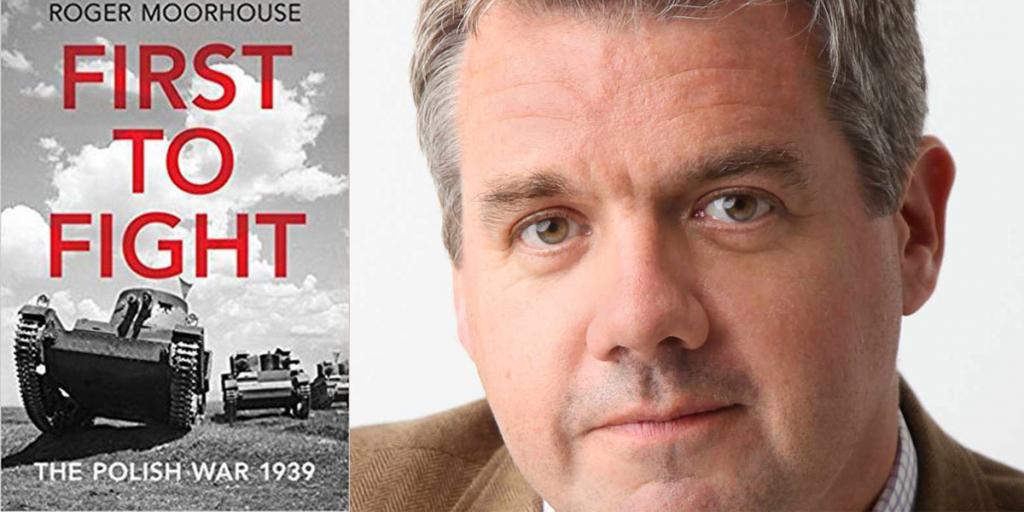
Author and historian Roger Moorhouse (source: Culture.pl)

Acclaimed author and historian Roger Moorhouse, whose Poland 1939 I had the pleasure of reviewing on this blog last weekend, accepted to answer my questions about Polish military history, the war of aggression against Ukraine and the leadership of President Volodymyr Zelensky. Below is the content of our exchange.

Mr. Moorhouse, thank you very much for taking the time to answer my questions, despite your busy schedule. While reading Poland 1939, I kept wondering if and what Western countries did to help the government of Warsaw in the crucial weeks and months leading to World War 2. Could you tell us more about that?

Not enough, is the short answer. There were military alliances signed with both the British and the French – the French one in May 1939, and commitments were made – specific in the French case, more vague in the British – to assist in the event of an invasion. The French committed to send “the bulk” of their forces across the Rhine on Day 15 of mobilization, and the British talked vaguely about sending RAF squadrons to Poland. Little of it, of course, came to pass once Germany actually invaded. The French made a half-hearted advance across the Rhine, and the RAF dropped leaflets over Germany politely asking that the Germans cease and desist. They then shifted the narrative from one of defending Poland to one of promising to restore an independent Poland at some time in the future. It was driven by circumstances, of course, but it was also morally rather cowardly.

Continue reading “Zelensky shows us what’s worth defending”

Putin is following Hitler’s blueprint

I started reading Poland 1939: The Outbreak of World War II by historian Roger Moorhouse last summer, with the intention of reviewing it on the 82nd anniversary of the tragic events that unfolded in September of that fateful year. But life caught up with me and the book remained unfinished on my desk for several months. That was until Vladimir Putin decided to invade Ukraine.

Let me start with an observation. Not much – not enough I should say – is written in English about Polish military history. I remember reading Adam Zamoyski’s Warsaw 1920 in 2012, when I first visited Poland. During that trip, I also visited the Field Cathedral of the Polish Army and the Warsaw Uprising Museum, both located in the capital city. Notwithstanding these contacts with Polish military history, I always have the image of Polish lancers attacking the mighty Wehrmacht in a useless charge.

Continue reading “Putin is following Hitler’s blueprint”

Zelensky is living up to what Churchill called “the level of events”

Source: Michael de Adder (@deAdder) / Twitter

Andrew Roberts is the contemporary authority on Winston Churchill. He gave an interview yesterday to Michael Crick for the Mail Online about the similarities between the Greatest Briton and Ukrainian President Volodymyr Zelensky, his contemporary disciple.

Here are a few lines from this insightful article:

“Not only has Zelenskyy stayed in Kyiv, as Churchill did in wartime London, but he is seen on the streets, rallying his people with speeches, and recognizes all the perils and risks.

‘It’s straight out of the Churchill playbook,’ Roberts tells Mail+. And Zelenskyy is showing extraordinary bravery when a team of Russian assassins dressed in Ukrainian army uniforms is said to be out to kill him. That’s not a hazard Churchill faced.”

Continue reading “Zelensky is living up to what Churchill called “the level of events””

« Nous avons été trop mous avec Poutine »

Le président ukrainien Volodymyr Zelensky (source: New York Post)

Les événements tragiques qui se déroulent en Ukraine depuis jeudi dernier me ramènent à la lecture du livre La honte de l’Occident, à l’intérieur duquel le journaliste Antoine Mariotti relate les tribulations diplomatico-militaires par lesquelles l’Occident a littéralement laissé le champ libre à Vladimir Poutine en Syrie. C’était il y a moins de 10 ans. Je ne peux m’empêcher d’identifier dans cet ouvrage la matrice du mode opératoire du Kremlin lorsqu’il décide que le temps est venu de faire déferler sa force militaire sur un sol étranger.

Je me suis donc entretenu avec M. Mariotti et j’ai recueilli ses observations relativement à la situation actuelle dans ce pays où Moscou veut imposer par les armes un second Holodomor (terme désignant la grande famine causée en Ukraine en 1932-1933 par Staline).

Voici le contenu de notre échange.

M. Mariotti, avez-vous été étonné de l’invasion de l’Ukraine par la Russie?

Pour être honnête, oui parce que j’avais « parié » qu’il n’irait pas. Je pensais que Poutine pousserait le bouchon aussi loin que possible pour mettre une pression diplomatique, politique et même militaire… mais je ne pensais pas qu’il s’engagerait dans une offensive si massive en Ukraine, pas en dehors du Donbass. Ce n’est toutefois pas une surprise et ce n’était pas impensable, comme ont pu le titrer certains médias, parce que cela fait des mois que l’on sait que le risque existe et plusieurs semaines que les États-Unis avertissaient qu’il allait envahir. Mais je pensais qu’avec cette pression, il ne lancerait pas une telle offensive.

poursuivre la lecture

Will Kyiv be another Stalingrad?

Adam Zamoyski (source: History Extra)

Few years ago, around the time I visited Poland for the first time, I devoured the insightful book Warsaw 1920 by acclaimed biographer and historian Adam Zamoyski. He is also the author of a masterful book about Napoleon’s invasion of Russia in 1812. I therefore reached out to him, asking if he saw any parallel between history and the current invasion of Ukraine by Russian troops. He generously accepted to share some thoughts with me and I’m extremely grateful for that.

Here is what the acclaimed biographer of Napoleon generously shared with me:  

The parallel that struck me, weeks ago, is that with 1811-1812, when Tsar Alexander I set as his condition for maintaining his alliance with Napoleon that the French Emperor issue a formal public declaration that he would never allow the re-creation of a Polish state. This was something that Napoleon would and could not do (any more than NATO could bind itself to refusing Ukraine membership if that country wished to join).

Continue reading “Will Kyiv be another Stalingrad?”

Heeding Wellington’s Advice

Dr. Seth G. Jones (source: CSIS)

In the aftermath of my review of his excellent book, Three Dangerous Men: Russia, China, Iran and the Rise of Irregular Warfare, its author Dr. Seth G. Jones accepted to answer my questions. Our exchange occurred before the start of the invasion of Ukraine. With cyber warfare at the disposal of current armies – like the crashing of the Kremlin website today – the content of this insightful book is ever more pertinent. And Dr. Jones is the best specialist to better understand this new way of conducting war.

Here is the content of this fascinating exchange.

Valery Gerasimov has been an avid student of U.S. military campaigns.

Dr. Jones, in Three Dangerous Men, one of the things I found most interesting was the reading habits of Russian General Valery Gerasimov. Apart from devouring tomes about Russian military doctrine and history, do you know if he is also interested in learning about Western figures and military episodes?

Valery Gerasimov has been an avid student of U.S. military campaigns. He closely studied U.S. operations in Bosnia, Kosovo, Afghanistan, Iraq, Libya, and other countries. Gerasimov concluded that the United States had moved away from what he called the “traditional” approach to warfare and toward a “new,” more clandestine approach, which he termed a “concealed use of force.” Gerasimov’s study of the United States was instrumental in evolving Russia’s own military doctrine, strategy, and tactics—including its use of irregular warfare.

Continue reading “Heeding Wellington’s Advice”

Les risques calculés de Pékin

La Chine dérange. Elle inquiète. Parce qu’on la méconnaît. C’est un réflexe naturel. Sa montée en puissance, notamment sur le plan militaire où elle occupe dorénavant la première place au niveau des forces navales, fait en sorte qu’on lui impute des desseins guerriers en mer de Chine méridionale ou même à Taïwan. Ce discours est notamment alimenté par un discours manichéen omniprésent dans des interventions médiatiques fréquemment réductrices et souvent alimentées par des observateurs nageant dans une superficialité nocive. 

Dans Guerres invisibles, Thomas Gomart écrit, et il vaut la peine de le citer, que « la guerre froide a donné naissance à plusieurs générations de kremlinologues qui cherchèrent à analyser les jeux politiques en URSS et dans le bloc communiste. Rares, très rares, sont aujourd’hui les spécialistes capables de saisir les rapports de force au sein du Parti communiste chinois (PCC). » À mesure que l’Empire du Milieu prend de l’ascendant sur l’échiquier international, force est de reconnaître qu’il importe de prêter l’oreille à ceux et celles qui ont pour vocation professionnelle de bien et mieux connaître ce pays.

poursuivre la lecture

« Car ce qui donne un sens à la vie, donne un sens à la mort » – Saint-Exupéry

L’Occident, c’est regrettable et néfaste, a voulu effacer la guerre de son horizon psychologique. Dans les années 1990, j’étudiais au baccalauréat en histoire et j’avais invité le chargé d’affaires de la République fédérale de Yougoslavie à Ottawa à venir prononcer une conférence devant mes collègues et moi. Certains avaient critiqué cette activité, au prétexte que la polémologie appartenait aux oubliettes des champs historiques surannés. À la manière d’un Francis Fukuyama, l’avenir leur donnerait tort.

Mais cette disposition à gommer la res militaris prive nos sociétés d’une véritable compréhension du métier des armes et de sa finalité fréquente. « Préserver son armée de pertes devenues inacceptables d’une part et en donner une image d’invulnérabilité aux yeux de l’ennemi d’autre part sont des avantages indéniables de cette nouvelle forme de conflictualité : la guerre à distance, la guerre « zéro mort », écrit Nicolas Zeller dans Corps et âme (Tallandier). Dans ce témoignage percutant de vérités, ce médecin des Forces spéciales françaises rappelle pourtant que « […] la guerre tuera toujours des hommes. »

poursuivre la lecture

L’histoire comme arme géopolitique

Lors d’une récente discussion, un ancien haut-gradé des Forces armées canadiennes me faisait prendre conscience à quel point la géopolitique nous affecte. Quotidiennement. Par exemple, au niveau des chaînes d’approvisionnement, lesquelles dépendent largement du transport maritime. Quand on sait que la principale route commerciale est celle qui relie la Chine à l’Europe par le canal de Suez, il y a tout lieu de s’intéresser de beaucoup plus près à ce qui se passe en mer de Chine. Mais comme c’est moins visible et criant que le bruit de bottes qui se font entendre actuellement aux frontières de l’Ukraine ou de l’exaspération découlant des négociations corsées avec l’Iran, on y prête moins attention.

C’est justement cet aspect inaudible des relations internationales que l’historien et spécialiste en géopolitique Thomas Gomart s’emploie à illustrer dans son dernier livre, Guerres invisibles : Nos prochains défis géopolitiques (Tallandier) dont je viens de terminer la passionnante lecture.

Poursuivre la lecture

Boris Johnson’s Thatcher Moment?

British Prime Minister Boris Johnson (source: The Telegraph)

British Prime Minister Boris Johnson is embroiled in a “Partygate” which might provoke the end of his premiership. For all we know and depending on the circumstances and the conclusions of the Sue Gray report, he might be living his last days at 10 Downing Street. Professor Tim Bale of Queen Mary University of London is one of the best specialists on the Conservative Party. Despite a busy schedule, he kindly accepted to answer a few questions for this blog.

Professor Bale, considering Mr. Johnson’s persona and past, do you think the organization of parties at 10 Downing Street while the rest of the UK was in lockdown was predictable?

Johnson has never considered rules as something that should constrain him, so it’s all too easy to believe that those parties took place and that he didn’t care.

Continue reading “Boris Johnson’s Thatcher Moment?”