The best books, their authors and the great people who inspire these stories / Les meilleurs livres, leurs auteurs et les grand.e.s de l'histoire qui les inspirent.
“Nothing great will ever be achieved without great men, and men are great only if they are determined to be so”, said Charles de Gaulle – Winston Churchill’s brother in arm during World War II. Resilience is the common thread of Martin Dugard’s new book Taking London: Winston Churchill and the Fight to Save Civilization (Dutton).
While de Gaulle escaped France with only 2 suitcases aboard the RAF plane that flew him into history on June 17, 1940, Churchill wasn’t much more gifted politically when he was asked to become Prime Minister a month earlier. The author reminds the reader that he was the second choice to occupy the role and that he had “no political currency beyond his words and beliefs.”
Yet, he had to keep the country – and the free world – safe from the claws of Nazism. Alone. A longtime admirer and promoter of the Royal Navy – which ruled the waves for centuries – Churchill had no choice but to realize that Nelson’s heirs couldn’t save Britain. Along with his legendary courage, the Royal Air Force was his only asset.
Dans les cours de relations internationales qui ont émaillé mes études universitaires, on nous savonnait les oreilles avec cette théorie selon laquelle la fin de la Guerre froide marquait la fin de la dominance de la geste militaire, du moins comme nous la connaissions jusque-là.
Le fracas des armes appartenait à une période révolue. Il fallait désormais composer avec « l’invention d’un nouveau concept d’opération militaire dont nous allions avoir le redoutable privilège d’inaugurer les contradictions insolubles », « l’intervention humanitaire », pour emprunter les mots utilisés par le général français François Lecointre (retraité) dans son livre Entre guerres(Gallimard).
De l’Irak à la Bosnie, en passant par le Rwanda et Djibouti – pour ne citer que quelques théâtres d’opérations – celui qui sera appelé à occuper la fonction de chef d’état-major des armées françaises entre 2017 et 2021 est issu d’une famille ayant contribué aux belles pages de l’histoire militaire française. Né en 1962, année de la crise de missiles à Cuba, la carrière de François Lecointre correspond à une période durant laquelle l’on croit que l’odeur du cambouis passe au second plan.
The best way for me to review this enthralling book is to get off the beaten path and summarize the 10 main takeaways that strike me the most.
1. Whatever you think of it, “war is still very much worth studying.” That’s the common thread of the book.
2. Totalitarian régimes have an easier time launching, conducting and bearing the brunt of war. The rise of autocracies throughout the world is therefore a challenge for democracies not accustomed with the pugilistic mindset.
3. Don’t cut military spending. “Money saved in piecemeal defense cuts often costs more in the long run.” The authors mention Great Britain’s decision to axe HMS Endurance before the Falklands War as a case in point. They also refer to Israel’s defense cuts after the Six Days War, with the consequences that followed six years later on the fateful morning of Kippur. Deterrence is cheap compared to war’s tribute in blood and treasure.
Let’s talk about an Israeli Prime Minister who is “an accomplished player in the rough-and-tumble world” of Jewish politics. An extremely talented communicator who can excite supporters and who plays on the American public scene like a virtuoso. At the same time, that leader generates strong feelings – positive and negative – among certain groups, particularly at home. This is a head of government whose political survival is threatened by an existential war launched against the country while its defenders are caught off guard.
Reading these lines, the image of Benjamin Netanyahu will certainly come to your mind. That is, if you are interested in current Israeli political history.
Considering the similarities quoted above, one could argue that the current Prime Minister walks in the footsteps of Golda Meir, in whose care the country was entrusted between 1969 and 1974.
I am fully aware that drawing parallels is a road on which one must tread carefully – after all these two leaders belong in two opposite ideological and partisan camps – but I could not avoid mentioning these striking parallels.
The life and career of the fourth Prime Minister of Israel – and only woman to occupy that function – have piqued my curiosity for quite a long time now. Thanks to the expertise and talent of Professor Deborah E. Lipstadt, who currently serves as the U.S State Department’s Special Envoy for Monitoring and Combating Antisemitism, an excellent opportunity has been granted me through Yale University Press’ excellent Jewish Lives Collection.
For several reasons, I have never really been a big fan of memoirs. As a student of Israeli Prime Minister Benjamin Netanyahu’s political vocation, I was nevertheless to dive enthusiastically into his autobiography, whose title is simply Bibi: My Story(Threshold Editions). I was not disappointed, because “Bibi” marshalled all his legendary talent as a communicator to convey the chapters of his life.
I could evoke his conservative philosophy – notably expressed in his revulsion when confronted with the “absurd bureaucracy” preventing the Prime Minister’s Office from getting a new Nespresso coffee machine for six months – his numerous dealings with world leaders from Ronald Reagan to Vladimir Putin and Donald Trump or even the Herculean task of overcoming his detractors and would-be political assassins. I could also mention his admirable historical knowledge and his significant affinity with the Bible and its landscape. Or the care he took to maintain a deep and lasting relationship with the Likud members – an essential ingredient in his political longevity. Maybe I should also have taken the time to explore the influence of Ze’ev Jabotinsky’s “Theory of Public Pressure” on his career. However, the focus of this review is to extract the main lessons – we could call them rules – from his absorbing journey.
As far back as reading his incredible columns in the Daily Telegraph, I have been fascinated with Boris Johnson. Throughout his media and political career, the former Prime Minister of the United Kingdom has intrigued and amused me while often making me reflect further on the parallels between the past and the present. In that regard, his riveting and difficult-to-match biography of Winston Churchill underlies how much both statesmen share many similarities, which probably explains why Boris Johnson undertook the process of writing this biography.
That impression was rekindled while I read Sebastian Payne’s absorbing book The Fall of Boris Johnson: The Full Story(Macmillan). Even though the story it recounts was painful at times – yes, I admit, I’m a fan of Boris Johnson and reading about his downfall didn’t make me particularly joyful – it was unquestionably the best political book I have read for years.
Winston Churchill and Boris Johnson will both go down in history as unrivalled communicators of their respective eras. It must have been hard for the latter’s communications shop to provide products that met the criteria of a man who was probably his own best speechwriter.
Any passerby on Whitehall in London walks in front of three statues representing towering British military figures of World War II. The most iconic one is naturally the one representing Viscount Montgomery, the victor of Alamein. Then there’s one of Viscount Alanbrooke, who headed the British Army during the conflict. The third and last one along the way – if you come from the House of Commons – depicts Viscount Slim, the victor of Burma. While I have devoured countless articles and books about Monty and read many things on Alanbrooke, my knowledge about the last member of the trio is scant at best. Mea culpa.
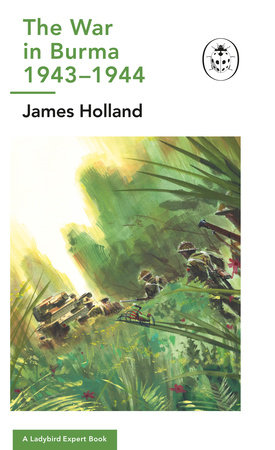
A few weeks ago, The War in Burma 1943-1944by renowned military historian James Holland came to my attention. I dove right into it with delight. True to his eloquence and unparalleled expertise (I’m a huge fan of his documentaries and I have another book of his on my shelves), this engaging historian broadened my horizons about an aspect and a figure of World War II about which I knew too little.
Published as part of the Ladybird Expert Book collection, the most recent addition to James Holland series is beautifully enhanced by Keith Burns’ stunning and evocative illustrations summarizes the significance of the much too unknown South-East Asian theatre of World War II. Northwest Burma, the prolific historian writes, was “one of the most inhospitable places to fight in the world.” By the end of 1944, the Japanese were on the move to smash British troops on their way to India, hopefully end the British Raj and thwart the delivery of essential supplies to Chiang Kai-shek’s Nationalists in China who were also fighting the Japanese toe and nails. The stakes were unparalleled, and the British couldn’t afford to lose any ground. Outnumbered and demoralized, how could they reverse the tide?
Russian President Vladimir Putin at the Kremlin on June 26, 2023 (Sputnik / Reuters)
I’m now at the age where I can say that I have observed, from afar, two coups initiated against a Russian ruler. The first one was plotted against Soviet President Mikhail Gorbachev in August 1991. The second one happened just a few days ago. I was glued to my Twitter account and CNN for most of last weekend, trying to keep abreast of developments between Rostov-on-Don and Moscow.
President Vladimir Putin being at the center of the events unfolding in these crucial hours, I believed it would be pertinent to reach out to the author of the best biography written about him to seek some insights. Philip Short, author of the seminal Putin (Holt), a book on which he worked for 8 years. Mr. Short generously agreed to answer a few questions, despite being buried under requests.
Here is the content of our discussion.
_________
Mr. Short, thank you very much for the generosity of your time.
I have a feeling that every time Vladimir Putin is referred to in the Western media, the analysis goes in the direction of his downfall – either by a coup, cancer or slipping on a banana peel. Would you tend to agree that this is wishful thinking disguised as analysis?
President Vladimir Putin’s biographer Philip Short (Macmillan)
I think we must recognize that we are in the middle of an information war that’s running parallel to the war on the ground in Ukraine. So, whether it’s wishful thinking or spin is arguable. Very often there are elements of both – added to which, western (and Russian) pundits have been pontificating very little hard information to go on, so there has been a lot of thumb-sucking of the ‘Putin’s finished’, ‘The end is nigh’, ‘Civil war beckons’, variety.
No one knows even exactly what Prigozhin was promised when he agreed to call off his mutiny. But certainly, the consensus in the Western media that Putin is severely weakened needs to be treated with skepticism. It’s just as plausible to make a case that his grip has in fact been strengthened because he found a way out which avoided the worst-case scenario of bloody fighting, and, to the elite, that is a signal that, even if he misjudged the situation early on, he hasn’t lost his touch, so ‘better to stick with the devil you know’.
Une mise en garde, avant toute chose. J’ai toujours été fasciné par Mikhaïl Gorbatchev, le dernier dirigeant de l’URSS. Mon sentiment envers lui a toujours été celui de l’admiration, et ce, dès son arrivée sur la scène internationale en 1985. Du haut de mes 11 ans, je m’affairais à lire tout ce qui le concernait. En 2011, j’ai eu l’insigne honneur de le rencontrer lors de son passage à la Chambre de commerce du Montréal métropolitain. De ses yeux jaillissait une flamme alimentée par la rencontre de l’autre.
Mikhaïl Gorbatchev était un homme profondément humain. C’est d’ailleurs l’un des principaux traits qui ressortent des Dernières conversations avec Gorbatchev(Robert Laffont), un livre découlant des entretiens réalisés sur une période de vingt-cinq ans par Darius Rochebin, journaliste chez LCI, avec le dernier dirigeant soviétique.
À 6 ans, les hommes de Staline viennent arrêter son grand-père maternel, Panteleï, devant ses yeux. Un souvenir qui restera gravé au cœur du garçon. Nous n’avons jamais que le pays de notre enfance, disait François Mitterrand si ma mémoire est fidèle. Même s’il devient « fin calculateur et rompu aux intrigues » du Parti communiste, le caractère de Gorbatchev a été coulé dans un moule bien différent. Il est « imperméable au frisson autoritaire ». À tel point que lorsqu’il arrive au pouvoir après le décès de Konstantin Tchernenko, il « […] rompt la série [des dirigeants qui ne rechignent pas à utiliser l’approche musclée pour asseoir leur pouvoir]. Pour la première fois, l’URSS a un chef profondément civil. Par expérience et par inclination naturelle, il répugne à l’usage de la force. » D’un couvert à l’autre, on fait la connaissance d’un homme qui ne veut pas faire couler le sang et qui ne sait pas garder rancune. Assez étrange chez un politicien, mais passons.
Photo de l’auteur Benoît Rondeau prise au mémorial dédié aux Forces britanniques à Ver-sur-Mer (courtoisie de Benoît Rondeau)
Benoît Rondeau est un auteur que j’apprécie particulièrement. Il apporte au lectorat francophone une compréhension singulière de l’histoire militaire de la Seconde Guerre mondiale. Son livre consacré au soldat britannique durant ce conflit offre au lecteur la possibilité de marcher au combat au son de la cornemuse et de profiter de quelques instants de répit pour savourer une tasse de thé.
Suite à la publication de ma recension de cette excellente lecture, il a aimablement accepté ma demande d’entrevue et je suis enchanté d’en partager le contenu avec vous aujourd’hui.
_______
Monsieur Rondeau, je suis tout d’abord curieux de savoir combien de temps vous avez consacré à la recherche et à la rédaction de ce livre?
Pour ce qui est de la recherche, il va de soi que l’ouvrage a intégré le fruit d’années passées à découvrir et à comprendre l’armée britannique pendant la Seconde Guerre mondiale. La phase de recherche et de rédaction spécifiquement consacrée à l’ouvrage proprement dit s’est étalée sur un an et demi.