Putin and Israel

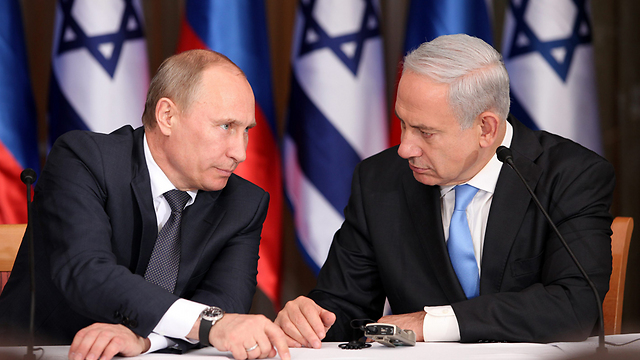
Russian President Vladimir Putin and Israeli Prime Minister Benjamin Netanyahu (Source: Ynetnews)

(version française)

There are lots of historic and major diplomatic announcements between Israel and Arab countries (UAE and Bahrain) these days, a development in which the United States are directly associated. In the last couple of years, we have observed the existence of another well-frequented diplomatic channel between Moscow and Jerusalem and I was very glad when acclaimed author Professor Mark Galeotti – author of an excellent biography of Vladimir Putin and more recently of A Short History of Russia – accepted to respond to a few questions about the subject a few weeks ago. Here is the content of our exchange.

Putin tends to respond well to tough interlocutors.

Do you think the election of pro-Russian Ariel Sharon as Prime Minister in 2001 played a role in President Putin’s stance about Israel?

I think it certainly helped in that Putin tends to respond well to tough interlocutors.

Israel is in many ways a Russian ally, despite some inevitable points of contention […].

Judging by the number of meetings between Prime Minister Netanyahu and President Putin (10 visits by Benjamin Netanyahu in Moscow since 2013 and 2 visits by Vladimir Putin in Israel since 2012), one could think that there is a notable rapprochement between Moscow and Jerusalem. How important is this relationship for the Russian president?

It’s important for both Putin and Russia. Israel is in many ways a Russian ally, despite some inevitable points of contention – when the IAF bombs Hezbollah positions in Syria, for example, the Russian air defense system there is not activated and clearly they have been forewarned. Likewise, Russia at times shares intelligence with Israel about Iran.

How important are the Middle East issues in Russian domestic politics? Is there a link between Russian domestic politics and President Putin’s relationship with Israel?

Honestly, it’s not really a factor – neither a plus, nor a minus.

Some observers are of the opinion that Israel is just a pawn on Russia’s chessboard. Could Russia become a key strategic ally of Israel in the near future?

That gives Israel too little credit. Yes, it has good relations with Russia (the first drones the Russians fielded were bought from Israel, for example), but it is not going to be anyone’s pawn.

Putin sends the signal that anti-Semitism is not acceptable.

You mention it briefly in your book (on page 75), when you mention that President Putin demonstrates “[…] no hint of anti-Semitism”, but could you tell us more about where he stands on the issue and what he does to confront this trend?

One can’t say that he has especially actively fought against it, but his evidently good relations with Israel and also the Chief Rabbi of Moscow are certainly powerful symbols to powerful and ambitious Russians that anti-Semitism is not acceptable.

Compared to the trend observable in other East European countries (like Poland for example), what is the current status of anti-Semitism in Russia?

It’s present, of course, but subjectively it feels in decline – in the 1990s one could often see anti-Semitic graffiti on the walls or slurs in the media, but both are much less evident today. In some ways an interesting development is that the extreme nationalists, from whom one might expect some prejudice, actually express respect for Israel in terms of its willingness to stand up for its own interests, with force if need be.

Apart from the President and the Prime Minister, who are the engineers of the relationship between the two countries? Is there any track II diplomacy involved in your opinion?

Pinchas Goldschmidt, the Chief Rabbi of Moscow, has been a very significant player in this respect – and, of course, there are many oligarchs and minigarchs of Jewish origins and often dual Russian-Israeli citizenship who act as connectors.

__________________

(version française)

Poutine et Israël

On assiste ces jours-ci à plusieurs annonces diplomatiques historiques et majeures entre Israël et des pays arabes (les Émirats arabes unis et le Bahreïn), un développement auquel les États-Unis sont directement associés. Dans les dernières années, nous avons observé l’existence d’un autre canal diplomatique très fréquenté entre Moscou et Jérusalem et j’étais très heureux que le Professeur Mark Galeotti – auteur réputé d’une excellente biographie de Vladimir Poutine et plus récemment du livre A Short History of Russia – accepte de répondre à quelques questions à ce sujet il y a quelques semaines. Voici le contenu de cet échange.

Poutine a tendance à bien réagir face à des interlocuteurs coriaces.

Pensez-vous que l’élection d’Ariel Sharon, qui était notoirement pro-russe, au poste de Premier ministre en 2001 a joué un rôle dans la position du président Poutine sur Israël?

Je pense que cela a certainement aidé, dans la mesure où Poutine a tendance à bien réagir face à des interlocuteurs coriaces.

Israël est, à bien des égards, un allié de la Russie, et ce, malgré certains points de frictions inévitables.

À en juger par le nombre de rencontres entre le Premier ministre Netanyahu et le président Poutine (10 visites de Benjamin Netanyahu à Moscou depuis 2013 et 2 visites de Vladimir Poutine en Israël depuis 2012), on pourrait penser qu’il y a un rapprochement notable entre Moscou et Jérusalem. Quelle est l’importance de cette relation pour le président russe?

C’est important pour Poutine et pour la Russie. Israël est, à bien des égards, un allié de la Russie, et ce, malgré certains points de frictions inévitables. Par exemple, lorsque l’IAF (les forces aériennes israéliennes) bombarde les positions du Hezbollah en Syrie, le système de défense aérienne russe n’est pas activé et les Russes ont clairement été prévenus. De même, la Russie partage parfois des renseignements avec Israël au sujet de l’Iran.

Quelle est l’importance des questions moyen-orientales dans la politique intérieure russe? Existe-t-il un lien entre la politique intérieure russe et les relations du président Poutine avec Israël?

Honnêtement, ce n’est pas vraiment un facteur – ce n’est ni un avantage, ni un inconvénient.

Certains observateurs estiment qu’Israël n’est qu’un pion sur l’échiquier russe. La Russie pourrait-elle devenir un allié stratégique clé d’Israël dans un avenir prochain?

Ce serait accorder trop peu de crédit à Israël. Oui, ce pays entretient de bonnes relations avec la Russie (les premiers drones russes qui sont entrés en fonction avaient été achetés en Israël, par exemple), mais Jérusalem ne deviendra le pion de personne.

Vous mentionnez brièvement, à la page 75 de votre livre, que le président Poutine ne manifeste « […] pas une once d’antisémitisme », mais pourriez-vous nous en dire davantage à propos de sa position sur le sujet et ce qu’il fait pour lutter contre ce fléau?

Poutine envoie le message que l’antisémitisme est inacceptable.

On ne peut pas dire qu’il l’a particulièrement activement combattu, mais ses relations manifestement bonnes avec Israël et avec le grand rabbin de Moscou sont certainement des symboles puissants pour les Russes influents et ambitieux à l’effet que l’antisémitisme est inacceptable.

Par rapport à la tendance observable dans d’autres pays d’Europe de l’Est (comme la Pologne par exemple), quel est l’état actuel de l’antisémitisme en Russie?

Le phénomène est présent, bien sûr, mais subjectivement, il semble en déclin – dans les années 1990, on pouvait souvent voir des graffitis antisémites sur les murs ou des insultes proférées dans les médias, mais les deux manifestations sont beaucoup moins évidentes aujourd’hui. À certains égards, une évolution intéressante est observable à l’effet que les nationalistes extrémistes, de qui on peut s’attendre à des préjugés, expriment en fait leur respect pour Israël, au niveau de sa volonté de défendre ses propres intérêts, avec force si nécessaire.

À part le président et le premier ministre, qui sont les architectes des relations entre les deux pays? À votre avis, y a-t-il une diplomatie parallèle à l’œuvre?

Pinchas Goldschmidt, le grand rabbin de Moscou, a été un acteur très important à cet égard – et, bien sûr, il existe de nombreux oligarques et minigarques d’origine juive et souvent détenteurs de la double nationalité russo-israélienne qui agissent comme entremetteurs.

Anti-Semitism ANZACS Australia Benjamin Netanyahu Canada Czech Republic France Gallipoli Histoire History Holocaust IDF Iran Iraq ISIS Israel Jerusalem Post Jewish Soldiers King and Country Mark Urban Middle East Military Military Expenditures Moshe Dayan NATO Poland Pope Francis Prince Harry Red Army Remembrance Revisionism Russia Saudi Arabia Terrorism The Edge Toy Soldiers Ukraine United States USSR US Troops Vladimir Putin World War I WW2 WWI WWII

De Gaulle, cet indocile

DeGaulleCointet2Winston Churchill a toujours occupé les premières loges de ma passion de l’histoire. Sa relation avec Charles de Gaulle m’a toujours fasciné, notamment en raison des nombreuses similitudes entre ces deux grands : impulsivité, génie, mélancolie passagère, éloquence, sens de l’histoire, caractère rebelle et j’en passe.
Mais De Gaulle ne serait pas devenu De Gaulle sans juin 1940 et, dans une certaine mesure, sans Churchill. Au moment de l’Appel du 18 juin, les deux hommes se distinguent pourtant par une feuille de route bien différente. Jean-Paul Cointet, dans son fascinant livre De Gaulle : Portrait d’un soldat en politique résume que lorsque le Général effectue ses premiers pas dans les arcanes de Whitehall, le Britannique et le Français cumulaient respectivement « […] trente-cinq ans d’expérience politique, de l’autre un tout récent sous-ministre. »

C’est dire à quel point De Gaulle a été contraint de se dépasser et de lutter pour assurer non seulement les intérêts de la France combattante, mais également les siens sur le plan personnel et ce, même si les deux peuvent facilement apparaître comme ayant été identiques, tellement le militaire français incarnait pratiquement à lui seul le mouvement dont il avait pris la tête.

Continue reading “De Gaulle, cet indocile”

Napoléon, le moine militaire

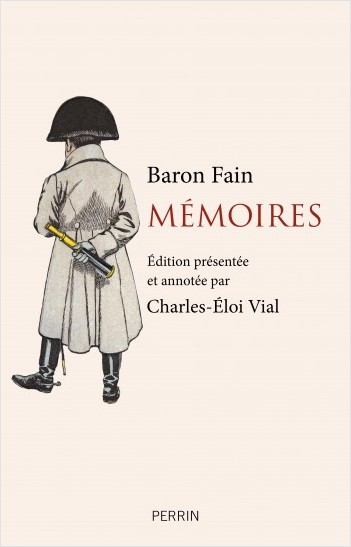
BaronFainMémoiresNapoléon fascine notamment par son génie militaire et l’empreinte qu’il a laissé dans l’histoire. Mais ce qui m’a toujours fasciné davantage, c’est l’homme et ses ressorts. Qu’est-ce qui le motivait, comment pensait-il et comment travaillait-il? Je piaffais donc d’impatience de plonger dans la récente édition des Mémoires du Baron Fain – qui fut l’un de ses plus proches collaborateurs – et qui viennent d’être éditées par l’historien et Napoléonologue Charles-Éloi Vial.
Dans un échange avec lui, l’auteur me précisait que Fain « fait partie de la « galaxie » napoléonienne, au même titre que Méneval, Duroc, Daru ou encore Bacler d’Albe ou Mounier. Ce sont les personnages qui se sont fait apprécier de l’Empereur pour leur ardeur au travail, leur efficacité et leur discrétion. Et comme Napoléon n’aime pas les nouvelles têtes, il les garde avec lui le plus longtemps possible. »

Outre l’admiration de Fain envers ce patron à qui il reconnaît des qualités de grande générosité, de méticulosité et de vaillance – l’expression « travailleur infatigable » revenant à quelques reprises – j’ai surtout été fasciné par les habitudes de lecture de celui que l’auteur compare à un « moine militaire » (j’adore l’expression), « gouvernant et administrant un empire immense du fond d’un cabinet secret, que cette retraite soit dérobée aux yeux par les lambris d’un palais ou par les rideaux d’une tente. » L’auteur l’évoque clairement et nous fait bien sentir au fil des pages que ce sanctuaire est l’endroit où Napoléon était le plus à l’aise pour travailler. Dans une dynamique régimentée dont les contours sont effectivement comparables à ceux de la vie monastique. Et c’est dans ce contexte qu’il l’a côtoyé.

Continue reading “Napoléon, le moine militaire”

A new Cold War with China seems inevitable

AdmiralJamesStavridis_UNDispatch
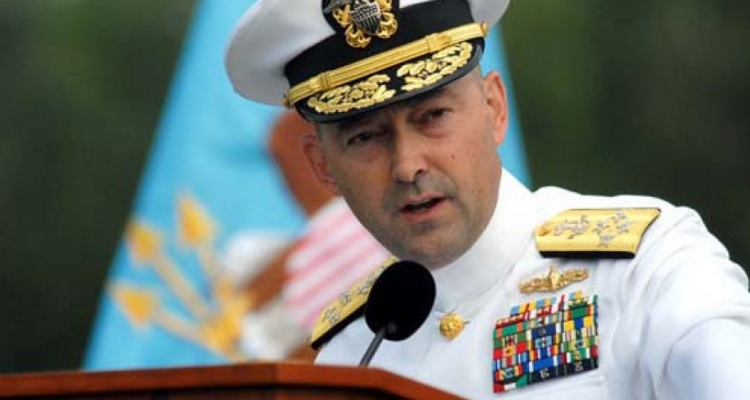
Retired four-star Navy Admiral and acclaimed author James Stavridis (Source: UN Dispatch)

(version française)

Retired Four-Star Admiral James Stavridis served as the 16th NATO Supreme Allied Commander – a function once occupied by the legendary General Dwight D. Eisenhower. In 2016, it was reported that he was vetted as a potential running mate for Democratic presidential candidate Hillary Clinton. He recently published an excellent book Sailing True North: Ten Admirals and the Voyage of Character which I recently had the privilege – and tremendous pleasure – to review here on this blog.

Having always been attached to the Fourth of July celebrations because of my deep admiration for the United States, it was my intention of publishing a special interview for the occasion. Admiral Stavridis generously accepted to answer my questions and I’m profoundly grateful.

There is absolutely no doubt in my mind that this book would be an excellent holiday read. Happy Fourth of July to all my American friends!

Here is the content of this insightful interview.

We are headed into a new Cold War with China. That seems inevitable now, but we need a strategy to avoid it turning into a shooting war. 

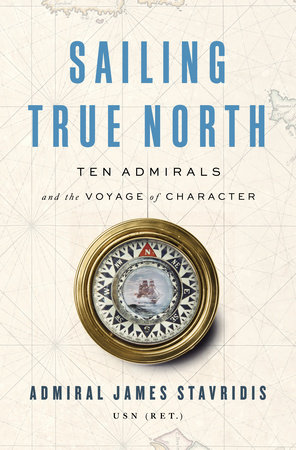
SailingTrueNorthIn Sailing True North, one of my favorite chapter (with the one devoted to Nelson) is the one about Zheng He. What do you think of the current tense situation with China and how do you think we should deal with that?
We are headed into a new Cold War with China. That seems inevitable now, but we need a strategy to avoid it turning into a shooting war. That will require a mix of diplomacy, military deterrence, tech savvy, economic tools (both in competition with China and in encouraging other nations to avoid Chinese “debt traps”). In essence, we should confront China where we must (cyber, trade, tariffs, their claims of “owning” the South China Sea) but cooperate where we can (environment, pandemics, arctic trade routes).  It will be a difficult and at times a dangerous passage. My next book, In Face, out in March 2021, is a novel about … a war with China! It is a cautionary tale, and let’s hope we don’t find it turning from fiction to fact before our eyes. Here’s a link to the Amazon page.

In the book, there are several references to religion, one to the Conclave, the other to John XXIII and Thomas Aquinas. I might be wrong, but I assume you are a Catholic and that faith seems to have had a significant impact on your journey. Am I wrong? Would you say that faith might also be an important buoy on the voyage of character?

I’m Greek Orthodox, and yes faith is vital for me personally – and for many others. Continue reading “A new Cold War with China seems inevitable”

Should We Fear Russia?

USSoldiersAfghanistan_Newsweek
US soldiers in Afghanistan (Source: Newsweek)

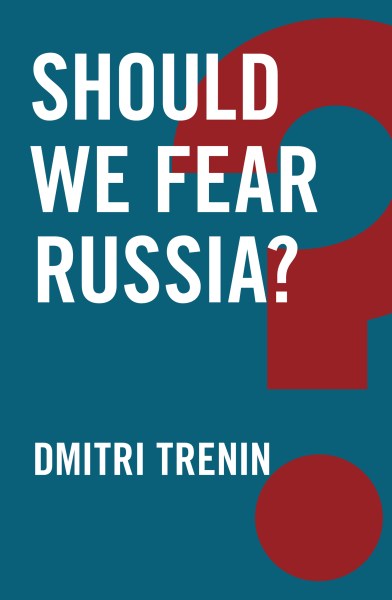
“Russia has no serious reason to fear the West », writes Dmitri Trenin – Director of the Carnegie Moscow Center – in his insightful book Should We Fear Russia? But President Vladimir Putin is not shy to “punch above his weight” and “always testing and pushing one’s boundaries” to ensure that Russia’s place at the table of great powers is respected.

ShouldWeFearRussiaAs I read these words, the New York Times revealed last Sunday that “United States intelligence officers and Special Operations forces in Afghanistan alerted their superiors as early as January to a suspected Russian plot to pay bounties to the Taliban to kill American troops in Afghanistan.

Then, another quote from Dr. Trenin came to mind: “Forcing his way to the high table, and making others deal with him out of necessity if not of choice, has become Vladimir Putin’s diplomatic trademark in his relations with US leaders.”

There is always a murky zone around special ops and covert operations, which always offer “plausible deniability” for operations like what allegedly happened in Afghanistan. Conventional wisdom would suggest that targeting soldiers for assassination does not appear like a good way to make and keep friends. But Moscow might get away with murder, since “for all its military superiority that it has been using elsewhere quite liberally, the United States lacks serious military options vis-à-vis Russia.” In other words, Vladimir Putin can continue pushing his luck with impunity.

Continue reading “Should We Fear Russia?”

Vladimir Putin, Defender of Russia’s Interests

VladimirPutin
President Vladimir Putin, participates in a wreath laying ceremony at the Tomb of Unknown Soldier in Moscow, Russia, on June 22, 2020 (Source: Spokesman.com)

Cliquez ici pour la version française

In just a couple hours, the heart of Russia will vibrate to the sound of patriotic military music. People will celebrate Victory Day and the 75th anniversary of the defeat of Nazi Germany – a feat that would have been impossible without Soviet contribution. President Vladimir Putin will be the host of the ceremony that will unfold in Moscow. Since he has been at the helm of Russia for 20 years and because it is realistic to think that he will carry on beyond the end of his current mandate in March 2024, I thought it might be interesting to conduct an interview about the President of the Federation with a leading expert of this country. Dr. Dmitri Trenin, author of many insightful books on the subject (I recently reviewed his captivating book about the history of Russia) and Director of the Carnegie Moscow Center, has generously accepted to answer my questions. Here is the content of our exchange.

Putin has broken the American monopoly in world affairs.

Entire forests have been used to print analysis and op-eds condemning President Putin and portraying him as a threat to the world’s stability. On the other side, your book about the history of Russia presents him as a leader who wants his country to be respected. What is his worldview and agenda?

DmitriTrenin
Dr. Dmitri Trenin

What you say depends on where you sit. For those defending the current – post-Cold War – order of unprecedented dominance of the United States and the liberal and democratic norms that the U.S. has established – upholds and polices, Vladimir Putin is a dangerous disruptor. Since his Munich speech of 2007, he has been publicly challenging U.S. global hegemony and since 2008 (pushing back against Georgia’s attempt to recover breakaway South Ossetia) and 2014 (intervening in Crimea and Eastern Ukraine) has been pushing back against Western geopolitical expansion. Putin has broken U.S. de facto monopoly on intervening in the Middle East by sending forces into Syria in 2015. The following year, Russia interfered with its information resources in U.S. domestic politics which stunned many Americans who are not used to foreigners seeking to influence them. Russia has also strengthened partnership with China, America’s principal challenger of the day. Moscow has energy assets in Venezuela, whose leadership Washington seeks to topple; it has a relationship with Iran and contacts with North Korea, two minor enemies of the United States. Above all, however, Russia, under Putin, has veered off the West’s political orbit; returned to the global scene as a great power; and rebuilt its military might. Russia, which had been relegated to yesterday’s news, an international has-been, a regional power at best (Obama) and a filling station masquerading as a country (McCain), made a stunning comeback.

Continue reading “Vladimir Putin, Defender of Russia’s Interests”

Wellington, seul vainqueur de Waterloo?

WaterlooThierryLentzL’été 2014 fut le plus beau de ma vie, en ce qu’il m’a offert le privilège de visiter une multitude de champs de bataille et lieux historiques sur le continent européen. De ceux-ci, Waterloo figurait en tête de liste. Ayant toujours nourri un vif intérêt envers le Duc de Wellington, j’étais fasciné de passer une bonne heure dans ce que fut son quartier général à l’époque (et qui porte maintenant le nom de Musée Wellington).

Ayant habité en Écosse pendant plusieurs mois suite à cette visite, j’avais accès à plusieurs livres publiés à propos de la légendaire bataille sur les mornes plaines – les Britanniques étant friands de commémorer leur contribution à la défaite de l’Aigle. Un bel après-midi d’hiver, alors que je me trouvais dans une librairie d’Édimbourg, mon regard se posa sur un petit livre de l’historien Brendan Simms portant sur la contribution des hommes de la King’s German Legion dans la défense de la ferme de la Haye Sainte – laquelle fut cruciale dans la victoire de Wellington et ses lieutenants.

Je me propose de rédiger quelques lignes bientôt à propos de cet ouvrage, mais je me limiterai ici à mentionner qu’il m’a ouvert les yeux sur le fait que Waterloo n’est pas exclusivement une victoire britannique, et ce, avec tout le respect que je dois à mes ancêtres écossais qui ont pris part à la bataille.

Cet état de fait est également soulevé de manière très éloquente par l’historien Thierry Lentz – qui est également directeur de la Fondation Napoléon – dans son excellent livre sur la bataille de Waterloo.

Après son retour aux Tuileries le 20 mars 1815, l’ancien Empereur déchu veut, selon les propos de l’auteur « convaincre l’Europe qu’il était décidé à vivre en paix avec elle, dans les frontières négociées en 1814 et sans velléité de reconquête d’aucune sorte. » Les participants du Congrès de Vienne refusent et « […] Napoléon devait en effet, une fois de plus, jouer son trône sur un coup de dés. »

Continue reading “Wellington, seul vainqueur de Waterloo?”

La définition du courage: Les soldats du Débarquement

SoldatsDDay_GilesMiltonJe me suis souvent posé la question à savoir comment se sentaient les soldats qui ont été parachutés et qui sont débarqués en Normandie dans le cadre de l’Opération Overlord. À la fin de l’été 2015, j’ai eu l’immense privilège de fouler le sable de Juno Beach, le secteur canadien du débarquement. Après la visite d’une position fortifiée, nous nous sommes dirigés sur la plage avec notre guide. J’ai alors été envahi d’un double sentiment. Je ressentais d’une part une très grande fierté de savoir que les bottes canadiennes ont traversé ce sol sacré pour libérer l’Europe de la horde brune. D’autre part, je ne pouvais m’empêcher de me demander comment ces hommes se sentaient au moment d’accomplir le destin auquel leur dévouement les appelait.

J’ai visionné la série Band of Brothers à d’innombrables reprises, ainsi que le film Saving Private Ryan avec l’incomparable Tom Hanks. Pour tout dire, l’épopée du débarquement en Normandie me fascine au plus haut point et j’ai lu quantité de livres sur le sujet. Mais aucun n’avait répondu à cette lancinante question qui m’habitait depuis des années.

Avant le début de la pandémie de la Covid-19, je me suis procuré un exemplaire du livre D-Day : Les soldats du Débarquement de l’historien écrivain britannique Giles Milton. D’abord à cause du sujet, mais aussi parce que j’apprécie particulièrement cet auteur qui donne toutes ses couleurs à la bravoure des hommes et des femmes en temps de guerre. Je vous parlerai un jour de son fameux Les saboteurs de l’ombre : Le guerre secrète de Churchill contre Hitler.

Continue reading “La définition du courage: Les soldats du Débarquement”

The importance of “Soft Power”

GeorgeHWBush_ChinaFile
President George H. W. Bush on Tiananman Square in Beijing (China), February 25, 1989 (Source: ChinaFile)

Cliquez ici pour la version française

Few years ago, I was captivated by Professor Joseph S. Nye Jr.’s book Soft Power: The Means to Success in World Politics. I recently approached the former Dean of the Harvard’s Kennedy School of Government and former Clinton administration official to submit him a few questions. He generously accepted to respond. Here is the content of our exchange.

You are the father of the term soft power. Just to make sure all my readers understand well, what would be the best short definition of this concept and why is it so important in international relations?

Power is the ability to affect others to get the outcomes you want and it is basic to international relations analysis.  You can affect others by coercion, payment, and attraction. Soft power is the ability to get what you want by attraction rather than coercion or payment.

Continue reading “The importance of “Soft Power””

FDR: The Fearless President

3DaysAtTheBrink_BretBaierI have always loved to read about FDR, one of my favorite Presidents. Being a fan of presidential libraries and having done some research in a few in the past, I have vivid memories of the time I spent at his inspiring Presidential Library at Hyde Park. I was therefore very interested in Bret Baier’s latest book, not only because it covers a period of contemporary history – World War II – for which I have an unquenchable intellectual thirst, but also because he dove into the presidential archives, a real treasure trove for anyone eager to fully understand the magnitude of the accomplishments of those larger than life Commanders in chief who lead America at crucial times.

The title of Bret Baier’s book Three Days at the Brink: FDR’s Daring Gamble to Win World War II refers to the Tehran Conference (1943), where the Big Three (FDR, Churchill and Stalin) agreed on the necessity to open a second front on the West – with Operation Overlord – to relieve some pressure on the Soviet troops, which occurred on June 6, 1944. But only a quarter of the book is devoted to the historic conference.

Continue reading “FDR: The Fearless President”