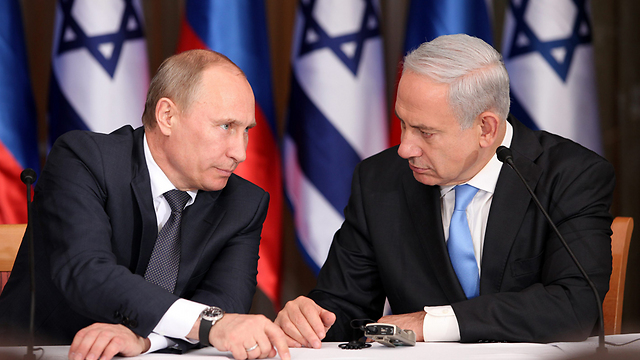
Putin and Israel

Russian President Vladimir Putin and Israeli Prime Minister Benjamin Netanyahu (Source: Ynetnews)

(version française)

There are lots of historic and major diplomatic announcements between Israel and Arab countries (UAE and Bahrain) these days, a development in which the United States are directly associated. In the last couple of years, we have observed the existence of another well-frequented diplomatic channel between Moscow and Jerusalem and I was very glad when acclaimed author Professor Mark Galeotti – author of an excellent biography of Vladimir Putin and more recently of A Short History of Russia – accepted to respond to a few questions about the subject a few weeks ago. Here is the content of our exchange.

Putin tends to respond well to tough interlocutors.

Do you think the election of pro-Russian Ariel Sharon as Prime Minister in 2001 played a role in President Putin’s stance about Israel?

I think it certainly helped in that Putin tends to respond well to tough interlocutors.

Israel is in many ways a Russian ally, despite some inevitable points of contention […].

Judging by the number of meetings between Prime Minister Netanyahu and President Putin (10 visits by Benjamin Netanyahu in Moscow since 2013 and 2 visits by Vladimir Putin in Israel since 2012), one could think that there is a notable rapprochement between Moscow and Jerusalem. How important is this relationship for the Russian president?

It’s important for both Putin and Russia. Israel is in many ways a Russian ally, despite some inevitable points of contention – when the IAF bombs Hezbollah positions in Syria, for example, the Russian air defense system there is not activated and clearly they have been forewarned. Likewise, Russia at times shares intelligence with Israel about Iran.

How important are the Middle East issues in Russian domestic politics? Is there a link between Russian domestic politics and President Putin’s relationship with Israel?

Honestly, it’s not really a factor – neither a plus, nor a minus.

Some observers are of the opinion that Israel is just a pawn on Russia’s chessboard. Could Russia become a key strategic ally of Israel in the near future?

That gives Israel too little credit. Yes, it has good relations with Russia (the first drones the Russians fielded were bought from Israel, for example), but it is not going to be anyone’s pawn.

Putin sends the signal that anti-Semitism is not acceptable.

You mention it briefly in your book (on page 75), when you mention that President Putin demonstrates “[…] no hint of anti-Semitism”, but could you tell us more about where he stands on the issue and what he does to confront this trend?

One can’t say that he has especially actively fought against it, but his evidently good relations with Israel and also the Chief Rabbi of Moscow are certainly powerful symbols to powerful and ambitious Russians that anti-Semitism is not acceptable.

Compared to the trend observable in other East European countries (like Poland for example), what is the current status of anti-Semitism in Russia?

It’s present, of course, but subjectively it feels in decline – in the 1990s one could often see anti-Semitic graffiti on the walls or slurs in the media, but both are much less evident today. In some ways an interesting development is that the extreme nationalists, from whom one might expect some prejudice, actually express respect for Israel in terms of its willingness to stand up for its own interests, with force if need be.

Apart from the President and the Prime Minister, who are the engineers of the relationship between the two countries? Is there any track II diplomacy involved in your opinion?

Pinchas Goldschmidt, the Chief Rabbi of Moscow, has been a very significant player in this respect – and, of course, there are many oligarchs and minigarchs of Jewish origins and often dual Russian-Israeli citizenship who act as connectors.

__________________

(version française)

Poutine et Israël

On assiste ces jours-ci à plusieurs annonces diplomatiques historiques et majeures entre Israël et des pays arabes (les Émirats arabes unis et le Bahreïn), un développement auquel les États-Unis sont directement associés. Dans les dernières années, nous avons observé l’existence d’un autre canal diplomatique très fréquenté entre Moscou et Jérusalem et j’étais très heureux que le Professeur Mark Galeotti – auteur réputé d’une excellente biographie de Vladimir Poutine et plus récemment du livre A Short History of Russia – accepte de répondre à quelques questions à ce sujet il y a quelques semaines. Voici le contenu de cet échange.

Poutine a tendance à bien réagir face à des interlocuteurs coriaces.

Pensez-vous que l’élection d’Ariel Sharon, qui était notoirement pro-russe, au poste de Premier ministre en 2001 a joué un rôle dans la position du président Poutine sur Israël?

Je pense que cela a certainement aidé, dans la mesure où Poutine a tendance à bien réagir face à des interlocuteurs coriaces.

Israël est, à bien des égards, un allié de la Russie, et ce, malgré certains points de frictions inévitables.

À en juger par le nombre de rencontres entre le Premier ministre Netanyahu et le président Poutine (10 visites de Benjamin Netanyahu à Moscou depuis 2013 et 2 visites de Vladimir Poutine en Israël depuis 2012), on pourrait penser qu’il y a un rapprochement notable entre Moscou et Jérusalem. Quelle est l’importance de cette relation pour le président russe?

C’est important pour Poutine et pour la Russie. Israël est, à bien des égards, un allié de la Russie, et ce, malgré certains points de frictions inévitables. Par exemple, lorsque l’IAF (les forces aériennes israéliennes) bombarde les positions du Hezbollah en Syrie, le système de défense aérienne russe n’est pas activé et les Russes ont clairement été prévenus. De même, la Russie partage parfois des renseignements avec Israël au sujet de l’Iran.

Quelle est l’importance des questions moyen-orientales dans la politique intérieure russe? Existe-t-il un lien entre la politique intérieure russe et les relations du président Poutine avec Israël?

Honnêtement, ce n’est pas vraiment un facteur – ce n’est ni un avantage, ni un inconvénient.

Certains observateurs estiment qu’Israël n’est qu’un pion sur l’échiquier russe. La Russie pourrait-elle devenir un allié stratégique clé d’Israël dans un avenir prochain?

Ce serait accorder trop peu de crédit à Israël. Oui, ce pays entretient de bonnes relations avec la Russie (les premiers drones russes qui sont entrés en fonction avaient été achetés en Israël, par exemple), mais Jérusalem ne deviendra le pion de personne.

Vous mentionnez brièvement, à la page 75 de votre livre, que le président Poutine ne manifeste « […] pas une once d’antisémitisme », mais pourriez-vous nous en dire davantage à propos de sa position sur le sujet et ce qu’il fait pour lutter contre ce fléau?

Poutine envoie le message que l’antisémitisme est inacceptable.

On ne peut pas dire qu’il l’a particulièrement activement combattu, mais ses relations manifestement bonnes avec Israël et avec le grand rabbin de Moscou sont certainement des symboles puissants pour les Russes influents et ambitieux à l’effet que l’antisémitisme est inacceptable.

Par rapport à la tendance observable dans d’autres pays d’Europe de l’Est (comme la Pologne par exemple), quel est l’état actuel de l’antisémitisme en Russie?

Le phénomène est présent, bien sûr, mais subjectivement, il semble en déclin – dans les années 1990, on pouvait souvent voir des graffitis antisémites sur les murs ou des insultes proférées dans les médias, mais les deux manifestations sont beaucoup moins évidentes aujourd’hui. À certains égards, une évolution intéressante est observable à l’effet que les nationalistes extrémistes, de qui on peut s’attendre à des préjugés, expriment en fait leur respect pour Israël, au niveau de sa volonté de défendre ses propres intérêts, avec force si nécessaire.

À part le président et le premier ministre, qui sont les architectes des relations entre les deux pays? À votre avis, y a-t-il une diplomatie parallèle à l’œuvre?

Pinchas Goldschmidt, le grand rabbin de Moscou, a été un acteur très important à cet égard – et, bien sûr, il existe de nombreux oligarques et minigarques d’origine juive et souvent détenteurs de la double nationalité russo-israélienne qui agissent comme entremetteurs.

Anti-Semitism ANZACS Australia Benjamin Netanyahu Canada Czech Republic France Gallipoli Histoire History Holocaust IDF Iran Iraq ISIS Israel Jerusalem Post Jewish Soldiers King and Country Mark Urban Middle East Military Military Expenditures Moshe Dayan NATO Poland Pope Francis Prince Harry Red Army Remembrance Revisionism Russia Saudi Arabia Terrorism The Edge Toy Soldiers Ukraine United States USSR US Troops Vladimir Putin World War I WW2 WWI WWII
A new Cold War with China seems inevitable

AdmiralJamesStavridis_UNDispatch
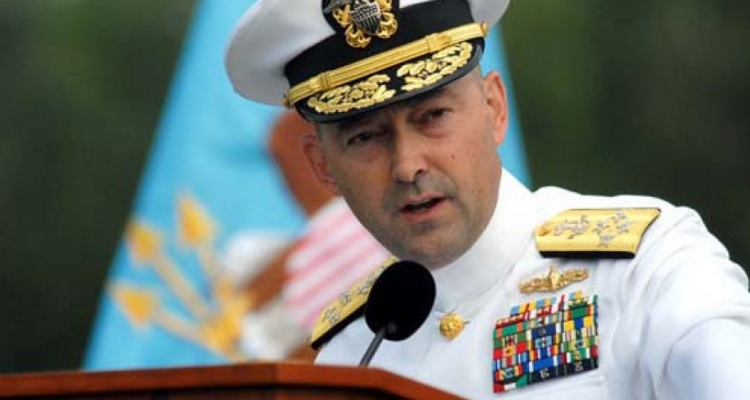
Retired four-star Navy Admiral and acclaimed author James Stavridis (Source: UN Dispatch)

(version française)

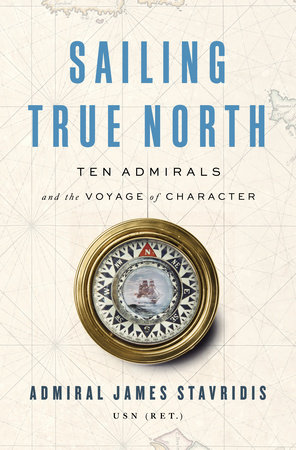
Retired Four-Star Admiral James Stavridis served as the 16th NATO Supreme Allied Commander – a function once occupied by the legendary General Dwight D. Eisenhower. In 2016, it was reported that he was vetted as a potential running mate for Democratic presidential candidate Hillary Clinton. He recently published an excellent book Sailing True North: Ten Admirals and the Voyage of Character which I recently had the privilege – and tremendous pleasure – to review here on this blog.

Having always been attached to the Fourth of July celebrations because of my deep admiration for the United States, it was my intention of publishing a special interview for the occasion. Admiral Stavridis generously accepted to answer my questions and I’m profoundly grateful.

There is absolutely no doubt in my mind that this book would be an excellent holiday read. Happy Fourth of July to all my American friends!

Here is the content of this insightful interview.

We are headed into a new Cold War with China. That seems inevitable now, but we need a strategy to avoid it turning into a shooting war. 

SailingTrueNorthIn Sailing True North, one of my favorite chapter (with the one devoted to Nelson) is the one about Zheng He. What do you think of the current tense situation with China and how do you think we should deal with that?
We are headed into a new Cold War with China. That seems inevitable now, but we need a strategy to avoid it turning into a shooting war. That will require a mix of diplomacy, military deterrence, tech savvy, economic tools (both in competition with China and in encouraging other nations to avoid Chinese “debt traps”). In essence, we should confront China where we must (cyber, trade, tariffs, their claims of “owning” the South China Sea) but cooperate where we can (environment, pandemics, arctic trade routes).  It will be a difficult and at times a dangerous passage. My next book, In Face, out in March 2021, is a novel about … a war with China! It is a cautionary tale, and let’s hope we don’t find it turning from fiction to fact before our eyes. Here’s a link to the Amazon page.

In the book, there are several references to religion, one to the Conclave, the other to John XXIII and Thomas Aquinas. I might be wrong, but I assume you are a Catholic and that faith seems to have had a significant impact on your journey. Am I wrong? Would you say that faith might also be an important buoy on the voyage of character?

I’m Greek Orthodox, and yes faith is vital for me personally – and for many others. Continue reading “A new Cold War with China seems inevitable” →

The importance of “Soft Power”

GeorgeHWBush_ChinaFile
President George H. W. Bush on Tiananman Square in Beijing (China), February 25, 1989 (Source: ChinaFile)

Cliquez ici pour la version française

Few years ago, I was captivated by Professor Joseph S. Nye Jr.’s book Soft Power: The Means to Success in World Politics. I recently approached the former Dean of the Harvard’s Kennedy School of Government and former Clinton administration official to submit him a few questions. He generously accepted to respond. Here is the content of our exchange.

You are the father of the term soft power. Just to make sure all my readers understand well, what would be the best short definition of this concept and why is it so important in international relations?

Power is the ability to affect others to get the outcomes you want and it is basic to international relations analysis.  You can affect others by coercion, payment, and attraction. Soft power is the ability to get what you want by attraction rather than coercion or payment.

Continue reading “The importance of “Soft Power”” →

FDR: The Fearless President

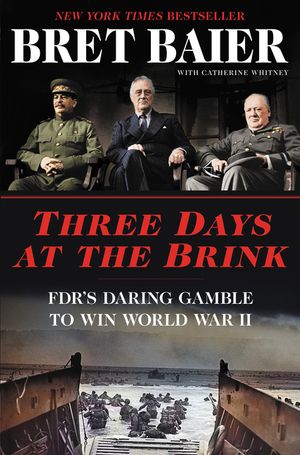
3DaysAtTheBrink_BretBaierI have always loved to read about FDR, one of my favorite Presidents. Being a fan of presidential libraries and having done some research in a few in the past, I have vivid memories of the time I spent at his inspiring Presidential Library at Hyde Park. I was therefore very interested in Bret Baier’s latest book, not only because it covers a period of contemporary history – World War II – for which I have an unquenchable intellectual thirst, but also because he dove into the presidential archives, a real treasure trove for anyone eager to fully understand the magnitude of the accomplishments of those larger than life Commanders in chief who lead America at crucial times.

The title of Bret Baier’s book Three Days at the Brink: FDR’s Daring Gamble to Win World War II refers to the Tehran Conference (1943), where the Big Three (FDR, Churchill and Stalin) agreed on the necessity to open a second front on the West – with Operation Overlord – to relieve some pressure on the Soviet troops, which occurred on June 6, 1944. But only a quarter of the book is devoted to the historic conference.

Continue reading “FDR: The Fearless President” →

The reading habits of Vladimir Putin

PutinReading
Russian President Vladimir Putin (source: Alexei Druzhinin/ Pool Sputnik Kremlin/Associated Press)

Cliquez ici pour la version française

The blogosphere is a jungle in which the blogger has to make his or her way. We depend on the interest we generate, beneficiaries of our readership.

For my part, I am constantly looking for subjects to discuss, books to devour and review and authors or historical figures to interview.

Upon closer examination of this blog, you will notice I am very interested in Russia, its history and its political life, especially its president.

A few weeks ago, I made a crazy bet, arousing the doubtful gaze of my loved ones. I got in touch with the Kremlin Press Office, asking if they would be willing to answer a few questions for this blog. To my surprise and delight, this request was met favourably, a privilege bestowed on few people I am sure.

The importance of this interview is not so much based on its content – one would have to be disconnected from reality to think that the assistants of the Russian President who work behind the mythical walls of the Kremlin will entrust secrets to a modest blogger – but rather on the fact that I got a response.

I am therefor very grateful toward the Press and Information Office of the President of the Russian Federation. Here is the Q&A about President Putin, followed by the French version of this exchange.

Who are President Putin’s favorite historical figures and why?

Generally the President is seriously interested in Russian history, although he has deep knowledge in world history, especially the history of the European continent. Vladimir Putin has sympathy for many statesmen in the history of our country, but perhaps most often in this regard he mentions Peter I. The role of Peter the Great can hardly be overestimated, it was him who laid the foundation of Russian Eurasianism [Editor’s note: a political ideology positioning Russia’s re-emergence as a conservative world power in opposition to the hegemony of the west and its values], which became the forerunner of the modern Russian state.

What is or what are his favorite(s) books / biographies? Continue reading “The reading habits of Vladimir Putin” →

Making James Bond Blush

TheForce_SaulDavidFew years ago, while visiting in Italy, I booked a talented guide to visit Monte Cassino and its vicinity. As I left the train, upon arriving in the bucolic town whose name is associated to one of the most famous battles of World War II, I was struck by the breathtaking landscape. Up above a steep mountain, the famous Benedictine Abbey lays towering over the surrounding valley.
I immediately wondered what kind of soldiers could conquer such a hostile environment and dislodge the Germans, ferociously guarding the impregnable summits forming the Winter Line set up to block the Allies on their way up North to the Eternal City, Rome.

Some years later and thanks to renowned military historian Saul David, I finally found the answer between the covers of the book The Force: The Legendary Special Ops Unit and WWII’s Mission Impossible. Assembled from scratch with Canadian and American soldiers in the summer of 1942 “for a top mission behind enemy lines”, the First Special Service Force was initially trained to operate in winter conditions with a new snow vehicle.

The mission of the unit soon became the object of turf wars and power plays between British and American top brass and politicians. While Churchill – who had a “”particular interest” in the Force” jealously fought toe and nails to reserve these exceptional warriors for an eventual foray in Norway (operation Jupiter), US Army chief of staff George Marshall considered such a venture to be a sideshow. The American warlord was certainly frustrated to exclude such a powerful tool from a vital theater of operations.

Continue reading “Making James Bond Blush” →

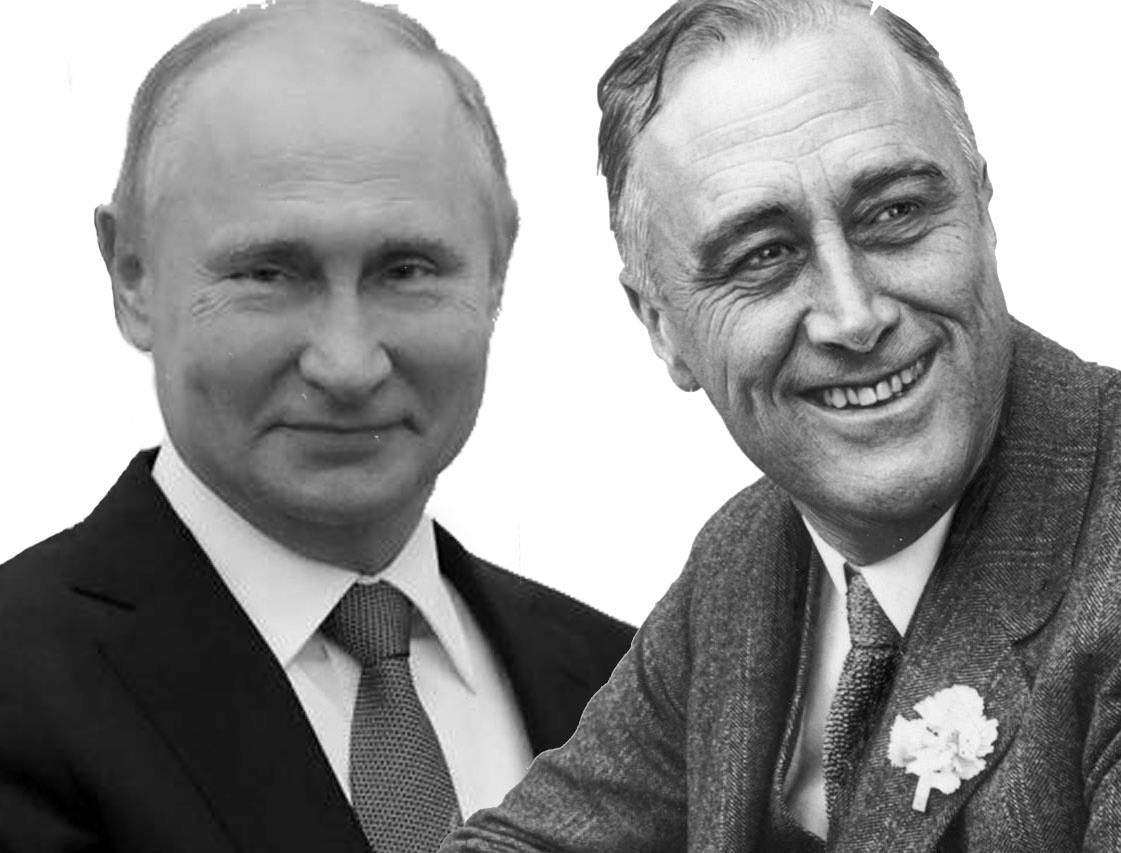
FDR was a role model for Vladimir Putin

PutinFDR

LA VERSION FRANÇAISE SUIT

After reading his insightful, well-written and gripping book about President Vladimir Putin, I asked Professor Mark Galeotti if he would accept to answer a few questions for this blog. He swiftly agreed and I’m very grateful for the generosity of his time. Here is the content of our exchange.

Many sincere thanks Pr. Galeotti for accepting to respond to a few questions for my blog.

His very privacy means we all get to imagine our own personal Putin…

PutinMarkGaleottiOn page 22 of your excellent book about President Putin, you write “If people think you are powerful, you are powerful.” On page 53, you refer to “purposeful theatricality”. In your book, Putin doesn’t come across as a bad person. Is there an important difference between the public and private persona of the Russian President? How is Mr. Putin different in private than what he shows in public?
The thing is that we really have very little sense of the true private self of Vladimir Putin: he absolutely protects that side of his life, and instead what we see is a guarded and carefully managed public persona. I think that for all the opulence of his lifestyle – the palaces, the personal staff, the thousand-dollar tracksuits – he is actually something of a lonely and distant figure, now almost trapped within the public persona, but this is very much my own imagining. In a way, that’s the point: his very privacy means we all get to imagine our own personal Putin…

On page 75, you debunk the notion that Vladimir Putin is some kind of social conservative (he notably upholds abortion rights), arguing that he is a pragmatist first. This notion is unfortunately not widely known in the West. Why do you think observers and commentators still hold to the notion that he is some kind of conservative ideologue?

Continue reading “FDR was a role model for Vladimir Putin” →

The art of making friends

AdmiralMcRaven_TaskAndPurpose
Admiral William H. McRaven (U.S. Navy Retired) (Source: Task & Purpose)

“Help as many people as you can. Make as many friends as you can. Work as hard as you can. And, no matter what happens, never quit!”

These are not the usual words or piece of advice you generally expect from a military figure like the retired commander of American Special Forces. But that’s the philosophy of Retired Admiral William M. McRaven, distilled in his most recent book Sea Stories: My Life of Special Operations.

Let me say it from the get-go. The book is pure joy to read. Not only because Admiral McRaven details his life as a Navy SEAL and the main operations in which he took part – like finding a crashed Navy airplane in the mountains of British Columbia (hey, I’m proud when a great author writes about my country), the capture of Saddam Hussein or the find and seek operation to neutralize Osama bin Laden (“the most successful special operation since World War II”). For a military enthusiast, those are great pages to read and the author has a gift for expressing himself eloquently and precisely. No word is superfluous.

But what amazed me the most is the mindset of that great military figure. If you haven’t yet, I invite you to watch the video of his speech inviting you to make your bed first thing in the morning then going about to change the world. Make your bed is also the title of a previous book by the famous Navy SEAL.

SeaStoriesImageAn outspoken believer in God and family man, Admiral McRaven also refers often to stoicism in his book – a predisposition also shared by none other than Former Defense Secretary and retired US Marines General James Mattis. Comfortable and at ease with his beliefs and values, he also finds no qualms in bringing terrorists to justice.
But what impressed me the most is what I learnt about the elected officials Admiral McRaven worked with and for. To that end, the following excerpt about his interaction with President George W. Bush regarding the neutralization of terrorist Abu Ghadiya (“the most wanted man outside Iraq”) in 2008 is worth quoting at length:

“At one point in the brief the President stopped me and asked, “Why are we sending the SOF guys in? Can’t we just drop a GBU‐31 on this guy?”

Continue reading “The art of making friends” →

Riding with Napoleon

AndrewRobertsLeadership

In April 2013, I made a point to be in London for Lady Thatcher’s funeral, on my way back to Canada from Rome. Throughout my youth, the former Prime Minister of Great Britain had always been one of my favorite leaders. It was therefore an honor to stand on the street and see her casket pass in front of me on a morning of reverence.

Just a few days ago, I finished reading Andrew Robert’s last book, Leadership in War: Essential Lessons from those who made history and, to my great delight, the 9th leader about whom he writes is Margaret Thatcher (the preceding 8 are Napoleon Bonaparte, Horatio Nelson, Winston Churchill, Adolf Hitler, Joseph Stalin, George C. Marshall, Charles de Gaulle and Dwight D. Eisenhower). I was pleasantly surprised. After all, if the Iron Lady doesn’t deserve a place in such a book, who does?

Thinking about leaders who left an indelible mark in military leadership makes one wonder how did they get there in history? Andrew Robert answers this question when he writes that: “Except through heredity, one does not become a war leader in the first place unless one has a strong personality.”

While it is easy to think and write about the qualities and strengths of great figures of history, it is no less important and vital to understand that, like us, they are humans. The first challenge they must meet is failure. For the road to success if filled with obstacles, but, as Winston Churchill would say, “sometimes, when she scowls most spitefully, [goddess Fortune] is preparing her most dazzling gifts.” Furthermore, you can’t please everyone. I found it almost unbelievable to read that “Although eight admirals, all of them in tears, carried his [Admiral Nelson’s] coffin, such was his controversial status in the Admiralty because of his ceaseless self-promotion and occasional refusal to obey orders that eighteen other admirals refused to attend.” How can anyone dare refuse attending the victor of Trafalgar’s funeral? Statesmen also need to cope with ungratefulness – like those dealing with Stalin and Charles de Gaulle learnt. Finally, you can’t afford modesty. After all, most of these leaders understood “[…] that if their reputations could help conquer, and thus save the lives of their men, who were they to be modest?” Hence, the myth created by de Gaulle to safeguard France’s self-respect during World War II.

But, more than anything, the leaders perform better when they’re profoundly humane. Those who know me are aware of my deep admiration for Churchill, but my favorite chapter is the one Andrew Roberts wrote about Napoleon. I loved to read about the Emperor’s obsession with his men’s boots (after all, his army covered lots of territory by foot), the fact that “he always made sure that wine from his own table was given to the sentries outside his door”, the fact that Napoleon didn’t hesitate to take his own medal of the Légion d’honneur to present it to a deserving soldier or having the feeling that you are observing the Emperor’s “superb filing system” while riding in his busy carriage moving across Europe on bumpy roads. I never was a big fan of the man derisively called the “God of War” by Clausewitz, but Andrew Roberts deserves the credit for turning the ship of my fascination in his direction.

Tomorrow, January 27th, will mark the 75th anniversary of the liberation of Auschwitz, let me say a few words about Margaret Thatcher again. Before picking up Leadership in War, I was totally unaware of her profound philo-Semitism – a disposition I share with her. It was also fascinating to read that “Churchill […] was theologically a lot closer to Judaism than to the Anglican Church into which he was born.” But I digress. Thatcher learnt from her father “[…] the superiority of decisive practical action over mere hand-wringing and vapid moralizing, of the kind that all too many appeasers – in the 1930s and since – have been guilty.” As the metastases of the antisemitic cancer are spreading throughout the world, men and women of goodwill who seek to fight this disease will have to take inspiration from Margaret Thatcher to wage this vital battle. But that’s another story for another post.

I’m writing it for the first time on this blog, but I have been saying it for years. Few authors compare to Andrew Roberts. He dips his pen in the most eloquent ink to bring to life figures who have heaps of lessons to teach us (sometimes about values not to espouse like in the case of Hitler or Stalin).

If there was one leader about whom I would love to know what Andrew Roberts has to say, it would be Moshe Dayan. He mentions him on a few occasions in the book. Just enough to tease, but who knows? We might see something published about the famous Israeli warlord by the author in the future.

Leadership in War is an essential addition on the bookshelves of any leadership enthusiast, whether in the business world, in politics or in the ranks of the military.

239 pages of exquisite intellectual pleasure.

_____________________________________________

Andrew Roberts, Leadership in War: Essential Lessons from those who made history, New York, Viking, 2019, 256 pages.

I would like to express my heartfelt gratitude to the fantastic Sharon Gill at Penguin Random House Canada for helping me with a review copy of this excellent book.

The Rehabilitation of Ehud Olmert

ShadowStrikeReading Yaakov Katz’s book Shadow Strike, one literally feels in the midst of security briefings or witnessing military preparations. The political and military climates detailed are just surreal, as the main character walks a treacherous tightrope. I once was told that a good author can describe a situation or person in a convincing manner, but an excellent one will sweep you up in the action, making you feel as if you were there. In the case of Shadow Strike, I was so engrossed by the story that it was almost impossible for me to put the book down, so anxious was I to know how it would unfold.

Sandwiched between two larger-than-life figures – Ariel Sharon and Benjamin Netanyahu – the career of Israel’s 12th Prime Minister, Ehud Olmert, would seem to many observers as a footnote in Israel’s political history. Yet, Olmert took a fateful decision in September 2007. A decision shrouded in secrecy, to preserve the security and survival of his country. The genesis and evolution of this decision is masterly explained by the author, who is also the editor-in-chief of the Jerusalem Post, in this gripping book.

EhudOlmert
Former Israeli Prime Minister Ehud Olmert. Source: https://www.calcalistech.com/ctech/articles/0,7340,L-3759710,00.html

After learning from the Mossad of the existence of a nuclear reactor in Bashar al Assad’s backyard, the Prime Minister took the decision to take it out before it could prove harmful to his fellow citizens. To this day, too few people realize and understand that Israel cannot gamble with its security.

Along the way, he could not afford the diplomatic option favored by the Bush administration.  He also had to cope with the opposition and difficult temper of his own Defense Minister, former Prime Minister Ehud Barak. Every step of the way, secrecy was of the utmost importance in order to ensure the mission’s successful completion but also not to provoke the retaliation of the Assad régime. From the get-go, Olmert was ready to soldier on, showing that his political spine was made of steel.

The fact that Ehud Olmert carried the day against all odds is a powerful testament to the fact that his mandate has not only been successful, even though it will definitely have been marked by humility. He might not have the persona of those tenacious fighters who, like Ariel Sharon, protected Israel in the unit 101 and 202 in the early years of the State, nor the unique eloquence and intellect of Benjamin Netanyahu, but Ehud Omert did what he had to do during these fateful days of 2007. He safeguarded Israel and its future at a very crucial moment.

If only for that, I’m thankful for Yaakov Katz not only because he is one of the most gifted writers I have had the pleasure to read, but also for convincing me that this man has been an underestimated statesman. It’s about time we express some sort of heartfelt gratitude – no matter the fallout of his premiership.

Personally, I hope I will someday have the opportunity and pleasure of telling him in person.

P.S. I’d like to express special thanks to Mr. Joseph Rinaldi, from St. Martin’s Press, for his precious assistance, which proved very helpful in the preparation of this review.

_____________________

Yaakov Katz, Shadow Strike: Inside Israel’s Secret Mission to Eliminate Syrian Nuclear Power, New York, St. Martin’s Press, 2019, 320 pages.